
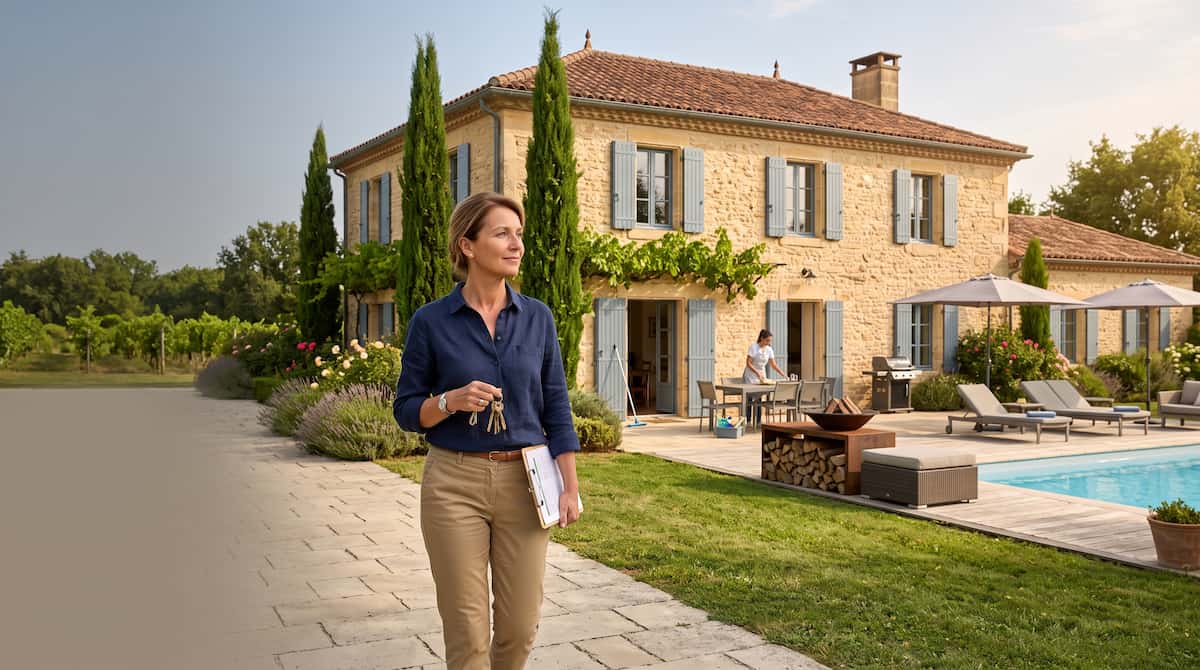
Owning a gîte or holiday home in France can be rewarding, but managing it from another country or even from the other side of France can quickly become complicated.
Guests need somewhere to stay, the property needs cleaning and maintenance, gardens need attention, pools need looking after, and problems can arise at exactly the wrong time.
Then there are the less visible responsibilities: insurance, taxation, local regulations, guest safety and the practical question of who can respond when you are hundreds of kilometres away.
For international property owners, having the right local support network can make the difference between a manageable holiday rental and a property that constantly demands your attention.
This guide explains the main areas to consider when running a gîte or holiday home in France and the types of local professionals you may need.
Important: This guide provides general information and is not legal, tax, insurance or regulatory advice. Requirements can depend on the property, its location, how it is operated and the services offered. Always confirm your specific obligations with the relevant French authority or qualified professional.
1. What does gîte management actually involve?
"Gîte management" can mean very different things depending on the property and the owner's involvement.
A hands-on owner might handle everything themselves. An overseas owner may need someone locally to coordinate almost every aspect of the property.
Typical responsibilities can include:
- Guest communication and bookings
- Check-in, welcoming, and check-out
- Keyholding and security checks
- Changeover cleaning, linen and laundry turnover
- Garden, lawn, and grounds maintenance
- Pool maintenance and water chemistry testing
- Minor repairs and urgent contractor call-outs
- Property storm inspections and winter checks
- Restocking consumables and rubbish/recycling management
You don't necessarily need one single company to do all of this. In many cases, it makes more sense to build a local network of trusted specialists.
2. Start with the question: how hands-on do you want to be?
Before choosing a management company or contractor network, decide how involved you actually want to be.
Fully managed
A local management provider coordinates most day-to-day operations. This is ideal if you live outside France, don't speak fluent French, or cannot attend the property regularly during the season.
Partially managed
You handle online bookings and guest messaging yourself, but outsource:
- Cleaning and changeovers
- Gardening and grounds
- Pool maintenance
- Keyholding and emergency call-outs
This offers a great balance for owners who want control over bookings while avoiding day-to-day physical tasks.
Owner managed
You handle most responsibilities yourself and bring in trade specialists when needed. This works well if the property is close to your primary residence.
The golden rule: Make sure someone specific is responsible for each task. A holiday property quickly develops problems if everyone assumes somebody else is looking after it.
3. Your local gîte support team
For many overseas owners, building a reliable team is essential:
- Keyholder: Meets contractors, responds to alarms, inspects after storms, and assists guests in emergencies.
- Cleaning & changeover team: Sanitises bathrooms, launders linen, remakes beds, cleans kitchens, and reports damage between bookings.
- Gardener / Grounds team: Manages rapid summer grass growth, hedges, irrigation, and driveway maintenance.
- Pool specialist: Handles weekly chlorination/pH testing, filter backwashing, opening, and winterisation.
- Plumber & Electrician on call: Critical for emergency boiler breakdowns, leaks, or power trips during guest stays.
- Heating / Air-conditioning technician: Ensures heat pumps, air conditioning, and woodburners operate safely year-round.
4. Keyholding: the most important service for overseas owners
If you live outside France, your keyholder is your eyes and ears on the ground.
Questions to ask potential keyholders:
- How often do you physically inspect the property during the off-season?
- Do you offer 24/7 emergency call-outs for guests?
- Can you meet tradespeople and supervise urgent repairs?
- How are keys securely stored, coded, and handed over?
- What is your emergency response time protocol?
Reliability and responsiveness matter more than distance alone.
5. Cleaning and changeover protocols
Cleaning is the single most visible part of a guest's experience. A stunning stone farmhouse with 5-star reviews can lose its reputation overnight from a rushed or substandard changeover.
Inside Checklist
- Bedrooms thoroughly cleaned, mattresses inspected, beds remade with fresh linen
- Bathrooms sanitised, showers descaled, fresh towels displayed
- Kitchen appliances cleaned (oven, fridge, dishwasher, microwave, toaster)
- Bins emptied, recycling sorted, consumables replenished (toiletries, dish tabs, coffee)
- Wi-Fi checked, TV tested, and welcome basket placed
Outside Checklist
- Terraces swept, outdoor furniture wiped down, BBQ cleaned
- Pool area tidied, sunlounger cushions prepared
- Obvious storm debris or garden hazards cleared
6. Pool management & French safety compliance
A swimming pool is a major booking draw, but also a serious legal and maintenance responsibility.
Mandatory French Pool Safety Standards (Loi n° 2003-9)
Under French law, private in-ground swimming pools for collective or rental use must have at least one approved safety device complying with AFNOR standards:
- Safety barriers & gates (NF P90-306): Physical perimeter fences preventing child access.
- Submerged or surface safety alarms (NF P90-307): Sounding an alarm if a child enters the water.
- Safety covers / slatted covers (NF P90-308): Capable of supporting the weight of an adult.
- Pool enclosures / shelters (NF P90-309): Telescopic or fixed pool domes.
Failure to comply can result in severe financial penalties and invalidation of public liability insurance. Always keep written proof of compliance from an approved pool specialist.
7. Garden & grounds maintenance
Rural properties in Southwest France (Dordogne, Lot-et-Garonne, Gironde) experience explosive vegetation growth between May and July.
Schedule regular mowing, strimming, hedge cutting, and irrigation checks so paying guests arrive to manicured grounds rather than an overgrown meadow.
8. Emergency protocols & spending authority
Receiving a message at 10:00 PM saying "The boiler stopped and the ceiling is leaking" requires immediate action.
Establish a Pre-Authorised Emergency Spending Limit
Give your local keyholder or property manager pre-approved written authority:
"The local manager is authorised to commission urgent emergency repairs up to €350 without prior written consent."
This allows a plumber or electrician to fix a burst pipe immediately rather than leaving guests stranded while trying to contact you across time zones.
9. Insurance: holiday letting requirements
Standard owner-occupied home insurance rarely covers short-term commercial holiday letting.
Ensure your policy explicitly covers:
- Short-term tourist holiday letting
- Comprehensive public liability (responsabilité civile propriétaire)
- Accidental damage by paying guests
- Swimming pool and outbuilding liabilities
- Loss of rental income following insured damage
Always request written confirmation of commercial letting cover from your broker.
10. Gîte taxation in France: BIC & LMNP frameworks
Furnished holiday accommodation in France is classified under the BIC (Bénéfices Industriels et Commerciaux) tax rules rather than standard property rental income:
Status Options:
- LMNP (Loueur en Meublé Non Professionnel): The standard regime for most gîte owners.
- LMP (Loueur en Meublé Professionnel): Applicable when rental revenue exceeds statutory thresholds and represents the majority of worldwide household income.
Tax Computation Regimes:
- Micro-BIC: Simplified flat-rate deemed expense deduction (with specific deduction rates for unclassified vs. officially classified meublé de tourisme).
- Régime Réel: Full deduction of actual operating expenses, mortgage interest, local property taxes, and structural property depreciation (amortissement).
Speak to an English-speaking French tax accountant to determine the optimal tax strategy for your circumstances.
11. Registration, classification & tourist tax (taxe de séjour)
- Mairie Declaration: Furnished holiday rentals must be registered with the local town hall using Cerfa n° 14004.
- Meublé de Tourisme Classification (1 to 5 stars): Optional formal star rating that can offer tax advantages and greater guest visibility.
- Taxe de Séjour: Local tourist tax collected per adult guest per night and paid to the local intercommunal authority. Ensure whether your booking platform collects this automatically or if you must remit it manually.
12. Gîte Management Checklist
- Local keyholder appointed with signed emergency protocols
- Cleaning & changeover team engaged with written inspection checklists
- Pool safety compliance certificate (AFNOR) on file
- Weekly pool chemical maintenance schedule confirmed
- Grounds and lawn mowing contracts established
- Commercial holiday letting insurance validated in writing
- Mairie declaration filed and tourist tax remittance protocol set
- Tax regime (micro-BIC vs. réel) reviewed with French accountant
- Guest welcome pack and bilingual emergency contact guide in place
Finding Gîte Management & Keyholding in Southwest France
If you operate a gîte or holiday home in Dordogne, Lot-et-Garonne, Gironde, or surrounding departments, VeriLocal connects you with verified local professionals:
- Find Gîte Management & Concierge Services
- Find English-Speaking Trades & Artisans
- Find Bilingual Tax Accountants
- Request Multiple Quotes for Property Management
VeriLocal is a verified discovery platform. Always confirm specific contractual terms and safety compliance directly with your appointed service providers.
Tell us what you need. We will find suitable local businesses.
Do not risk hiring unverified contractors. Describe your project once and receive matched introductions to up to 3 verified local businesses with checked SIRET registrations and active Décennale insurance.


