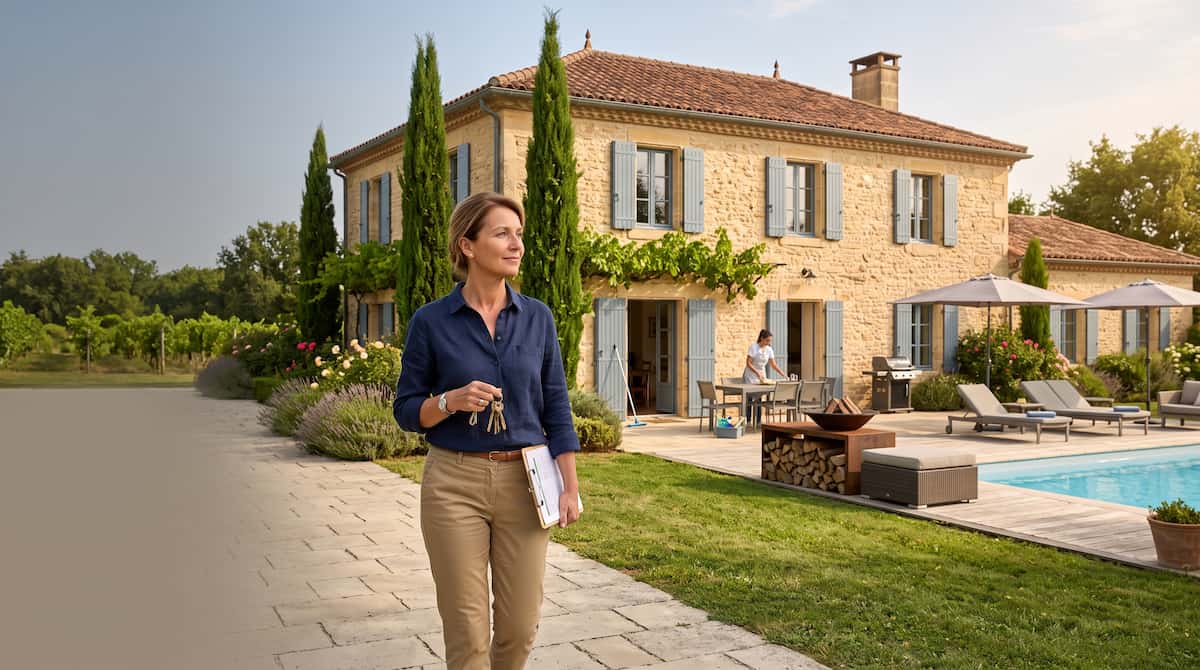

For thousands of international property owners across Southwest France, an outdoor swimming pool is the crown jewel of a summer holiday rental. In warm regions like the Dordogne, Lot-et-Garonne, Gironde, and Gers, a well-maintained pool is not merely a luxury; it is the single most decisive feature for securing peak summer bookings and command premium weekly rates.
However, operating a swimming pool in a French holiday let carries serious statutory obligations and personal liabilities. In France, private swimming pools are governed by strict public safety legislation designed to eliminate accidental child drownings.
If you let your French country home, cottage, or farmhouse as a holiday rental (meublé de tourisme or gîte), you cannot treat your pool as a private domestic amenity. Under French law, paying guests transform the property into a commercial establishment for safety liability. Failing to install, maintain, or document certified safety equipment exposes owners to heavy financial penalties and direct personal criminal prosecution.
This comprehensive guide details the statutory requirements of French Law No. 2003-9, the four approved AFNOR safety standards, the legal liabilities you face, and the practical operational protocols required to protect both your guests and your investment.
1. The Legal Framework: French Law No. 2003-9
Following a series of tragic domestic accidents in the late 1990s, the French Parliament passed Law No. 2003-9 of 3 January 2003, codified in Articles L. 134-10 and R. 134-10 to R. 134-15 of the Code de la construction et de l'habitation.
Scope of the Legislation
The safety legislation applies to:
- All private outdoor swimming pools whose basin is either completely or partially buried in the ground (inground or semi-inground).
- Pools belonging to individual holiday rentals, gîtes, seasonal lets, bed and breakfasts (chambres d'hôtes), and private family villas.
Key Exemptions
The law does not apply to:
- Indoor swimming pools contained within an enclosed building.
- Completely above-ground portable pools that are dismantled at the end of the season (though owners remain subject to general civil duty of care).
- Supervised public municipal pools and commercial water parks subject to lifeguard regulations.
The core statutory requirement is unequivocal: every outdoor inground or semi-inground pool must be equipped with at least one standardized safety device conforming to official AFNOR standards before guests arrive on site.
2. The Four Statutory AFNOR Safety Standards
The French standards association (Association Française de Normalisation - AFNOR) has established four mutually exclusive technical standards. An owner must install at least one of these four systems. Combining multiple systems (for example, a safety barrier plus a pool alarm) is permitted and strongly recommended for holiday rentals, but at least one must strictly satisfy the statutory technical specification.
A. Safety Barriers and Self-Closing Gates (Standard NF P90-306)
Protective barriers physically isolate the pool basin from the rest of the garden, terrace, and house. In the hospitality sector, physical fencing is widely considered by French insurers to be the safest and most reliable primary deterrent against toddler intrusion.
To comply with NF P90-306, the installation must respect several non-negotiable physical dimensions:
- Minimum Height: The fence must have a minimum finished height of 1.10 metres measured from the ground or any foothold within 1.10 metres of the barrier.
- Child-Proof Gate Latch: The access gate must open outwards away from the pool and feature a self-closing, self-latching mechanism. The locking latch must require two simultaneous, independent manual actions to release, preventing a child under five years old from opening it.
- Bar Gaps and Footholds: Vertical bars must have a clear gap of no more than 10.2 centimetres to prevent a child's head or torso from passing through. Horizontal rails must be spaced widely enough or designed without protrusions so that small children cannot use them as climbing rungs.
- Structural Resistance: The barrier and its posts must withstand a horizontal impact of 50 kg without bending or detaching from the ground anchors.
B. Pool Alarms (Standard NF P90-307)
Pool alarms provide electronic detection when an unexpected intrusion occurs. There are two primary categories under NF P90-307-1:
- Submerged Immersion Sensors: Mounted on the pool coping, these sensors monitor acoustic and hydrostatic pressure waves in the water. They must detect the fall of a child weighing 6 kilograms or more within seconds.
- Perimeter Infra-Red Beams: Optical transmitters and receivers surround the perimeter of the pool deck, sounding an alert as soon as an invisible beam is broken before a child reaches the water edge.
Critical Warning for Holiday Lets:
While alarms are the least expensive system to install initially, they pose significant operational challenges in holiday rentals:
- The Siren Must Be Audible: The alarm must emit a continuous siren of at least 100 dB measured at 1 metre distance, audible throughout the rental property.
- Automatic Reactivation: The system must automatically reactivate within a maximum of 3 minutes after swimmers leave the water. Manual systems that require guests to remember to turn the alarm back on are non-compliant and dangerous.
- Wind and Robotic Cleaners: Rural summer storms or automatic pool cleaning robots frequently trigger false alarms, prompting frustrated guests to power down the system, completely nullifying your insurance cover.
C. Safety Covers and Slat Covers (Standard NF P90-308)
Safety covers seal the surface of the water when the pool is not actively in use. Under NF P90-308, acceptable covers include:
- Rigid automatic slat covers (volets roulants immergés ou hors-sol), either motorized or manually operated via a secure key-switch.
- Heavy-duty reinforced safety tarpaulins supported by transversal aluminum bars (bâches à barres).
- Secure tensioned safety mesh fastened to flush anchor pins around the stone coping.
The 100 kg Load Test:
A compliant safety cover must be capable of supporting the weight of an adult weighing up to 100 kilograms walking across the surface without the cover breaking, unhooking, or deflecting into the water enough to allow immersion.
D. Enclosed Pool Shelters and Verandas (Standard NF P90-309)
Pool shelters (abris de piscine) range from low-profile sliding domes to high-ceiling glazed verandas that enclose the entire pool deck.
Under standard NF P90-309, the structure must:
- Completely prevent unsupervised access when closed, with all sliding panels, doors, and hatches secured by child-proof locks.
- Withstand extreme weather conditions, specifically winds of up to 100 km/h and localized snow loads of at least 45 kg/m² (essential in elevated parts of the Dordogne or Massif Central).
3. Legal Penalties & Personal Criminal Liability
Many international homeowners mistakenly assume that pool non-compliance is a minor administrative infraction that can be settled with a small fine. Under French jurisprudence, the reality is far more severe.
Administrative & Financial Fines
Under Article L. 152-12 of the Construction Code, any owner who fails to equip their outdoor pool with a compliant safety device is subject to a criminal fine of up to €45,000. If the holiday home is owned through a commercial French company (such as an SCI or SARL), the legal entity itself can be fined up to €225,000.
Personal Criminal Prosecution
In the tragic event that a guest, visiting child, or neighbor drowns or suffers severe neurological injury from submersion:
- The public prosecutor (Procureur de la République) will open a formal criminal investigation.
- If the pool lacked an AFNOR-certified device, or if the device was broken, deactivated, or incorrectly installed, the owner can be charged with involuntary manslaughter (homicide involontaire) or causing accidental bodily harm (blessures involontaires) under Articles 221-6 and 222-19 of the French Penal Code.
- Penalties include up to 3 years imprisonment and a €45,000 fine, increasing to 5 years imprisonment and a €75,000 fine if the court establishes deliberate violation of a statutory safety obligation (manquement délibéré à une obligation de sécurité).
Total Denial of Insurance Cover
French property insurance policies for holiday rentals contain strict statutory compliance clauses. If an accident occurs and you cannot present a valid Attestation de Conformité (Certificate of Conformity) dated prior to the event, your insurer will invoke an exclusion clause and refuse all public liability cover (responsabilité civile).
You will become personally liable for medical treatment expenses, air ambulance repatriation, lifetime care costs, and civil damages, which routinely run into millions of euros.
4. Operational Protocols: Turnover Days & The Safety Logbook
Installing compliant equipment is only half the battle. As a gîte owner, you must demonstrate active, diligent maintenance throughout the rental season.
The Pool Safety Logbook (Carnet d'Entretien)
Every holiday rental with a swimming pool should maintain a dedicated on-site pool logbook. At each weekly changeover (typically Saturday mornings), the owner or local keyholding service should record:
- Date and Time of Inspection: Signed by the person carrying out the checks.
- Safety Device Operational Test:
- Barrier gate checked for self-closure and latching from open positions.
- Pool alarm tested (battery status, audible siren check, automatic reactivation).
- Cover inspected for tear-free fabric and secure anchor strap tension.
- Chemical Balance & Disinfection Levels:
- Free Chlorine / Bromine level (recommended: 1.5 to 3.0 mg/L for chlorine).
- Water pH (must remain between 7.2 and 7.4 to prevent eye irritation and equipment corrosion).
- Water clarity check (a cloudy pool prevents visual bottom inspections and constitutes a safety defect).
- Physical Obstacles & Cleanliness: Skimmer baskets emptied, water level topped up to mid-skimmer height, and pool robotic cleaner removed prior to guest arrival.
For practical advice on organizing dependable changeover teams and keyholders, see our dedicated guide to Managing Changeovers and Keyholding in France.
5. Guest Information & Emergency Equipment
French consumer safety authorities recommend displaying clear bilingual safety guidelines in the welcome pack and at the pool house entrance:
- Clear Pool Rules: Bilingual notices stating that children must be supervised at all times by a responsible adult, running and diving in shallow ends are prohibited, and gates/covers must be closed immediately after swimming.
- Emergency Telephone Numbers: Prominently display local French emergency dispatch contacts:
- 15: SAMU (Medical Emergencies / Ambulance)
- 18: Sapeurs-Pompiers (Fire and Rescue / First Aid)
- 112: European Emergency Number (Multilingual operators)
- Local Mairie & Doctor: Address and phone numbers of the nearest medical centre.
- Reachable Rescue Equipment: Mount a certified life-buoy (bouée de sauvetage) with throwing line and an emergency reaching pole (perche de sauvetage) within sight of the pool deck.
6. Hiring Certified Pool Specialists in Southwest France
Maintaining, modifying, or renovating a swimming pool in a commercial holiday rental requires qualified professionals. Understanding which trade certifications apply protects you from liability.
Routine Maintenance vs. Structural Works
- Routine Servicing & Water Balancing: Can be performed by a general property manager, keyholder, or pool service company. They must hold active Professional Civil Liability insurance (RC Pro).
- Structural Construction, Liner Replacement & Underground Plumbing: Any contractor building a pool basin, replacing an underground suction line, applying structural fiberglass, or installing a heat pump must carry valid 10-year defect insurance (Garantie Décennale). For more details, consult our complete guide on How Garantie Décennale Works in France.
Essential Resources for French Holiday Rental Owners
Tell us what you need. We will find suitable local businesses.
Do not risk hiring unverified contractors. Describe your project once and receive matched introductions to up to 3 verified local businesses with checked SIRET registrations and active Décennale insurance.