How to Find a Bilingual Estate Agent in France
Buying or selling property in France can be complicated enough without a language barrier.
For English-speaking buyers, sellers and overseas property owners, finding an English-speaking or bilingual estate agent in France can make the process considerably easier. A good agent should do more than translate property descriptions. They should be able to explain French property terminology, communicate clearly with other professionals and help you understand how the French property market works.
The French term you are likely to encounter is agent immobilier. If you are searching in French, you may also see terms such as agent immobilier bilingue, agence immobilière bilingue or agent immobilier anglophone.
But being able to speak English is only one part of choosing the right property professional.
You also need to consider their local knowledge, professional status, experience with international clients, communication style and the type of property transaction you are undertaking.
This guide explains what to look for when choosing a bilingual estate agent in France and how to carry out sensible checks before giving an agent a mandate.
Looking for a bilingual property professional in Southwest France? Visit VeriLocal's Immobilier & Real Estate directory to explore the property services and specialist categories available across the region.
Why use a bilingual estate agent in France?
Buying property in another country involves much more than finding a house you like.
You may need to communicate with:
- The estate agent
- The seller
- A notaire
- Surveyors and diagnosticians
- Mortgage providers
- Insurance companies
- Architects
- Builders and other contractors
- Local authorities
- Property managers
- Tax or legal advisers
Much of this communication will take place in French.
A bilingual estate agent can help bridge that gap during the property search and transaction. They may also understand the concerns that are particularly relevant to international buyers, such as differences between French and British property terminology, the role of the notaire and the importance of checking a property's legal and physical condition before committing to a purchase.
However, English-speaking does not automatically mean better qualified.
Language ability should be one of your selection criteria, not the only one.
What does "bilingual estate agent" mean in France?
There is no special professional qualification simply for being bilingual.
An estate agent might describe themselves as bilingual because they speak French and English fluently, while another might operate primarily in French but have English-speaking staff or negotiators.
It is therefore worth asking exactly what "bilingual" means in practice.
For example:
- Can the agent conduct property viewings in English?
- Can they explain French legal and property terminology?
- Can they communicate with French-speaking professionals on your behalf?
- Can they explain documents before you pass them to your legal adviser?
- Do they regularly work with English-speaking buyers?
- Can they communicate with you throughout the transaction rather than only during the initial property search?
A genuinely useful bilingual service should make communication easier without giving the impression that the agent is replacing your notaire, lawyer, surveyor or other professional advisers.
What should you check before choosing an agent immobilier?
The French estate agency profession is regulated.
According to the French Directorate-General for Competition, Consumer Affairs and Fraud Prevention (DGCCRF), an estate agent operating as an agent immobilier must hold an appropriate professional card issued by the relevant Chamber of Commerce and Industry (CCI). The profession is regulated under the Loi Hoguet framework. Agents are also subject to requirements concerning professional liability insurance and, where applicable, financial guarantees.
That makes professional verification an important part of your research.
1. Check the professional status
Ask the agency or professional for their relevant professional details.
Depending on the activity, you may encounter different professional roles and authorisations. An agent immobilier involved in property transactions should have the appropriate professional credentials, while negotiators and commercial agents may operate under the authorisation of a professional holding the relevant card.
The distinction matters because not everyone who negotiates property is themselves the holder of the professional card.
The French government explains that negotiators working for an estate agent must have appropriate authorisation, while commercial agents operate under the authority of the professional holding the card.
2. Check the agency's SIRET and business details
A professional estate agency should be identifiable as a legitimate French business.
Check that:
- The business name matches the information provided
- The SIRET/SIREN information is consistent
- The business address is genuine
- The agency's stated activity matches the service it is offering
- Professional information is clearly displayed
This is particularly useful when dealing with a business you have discovered through social media, a property forum or an independent website.
3. Ask about professional insurance and guarantees
French property professionals operate within a regulated framework that includes professional liability insurance and, depending on their activities and whether they handle client funds, financial guarantee requirements.
Don't be afraid to ask an agency to explain its professional credentials.
A reputable professional should understand why an international buyer wants to carry out basic due diligence.
Does an English-speaking estate agent need to be French?
Not necessarily.
The important issue is whether the professional is legally authorised to perform the activities they are undertaking.
Someone might be an English-speaking property negotiator working under a French agency rather than the holder of the agency's professional card themselves.
That isn't necessarily a problem.
What matters is understanding who you are dealing with and who is legally responsible for the transaction.
If an individual is negotiating property on behalf of an agency, ask which agency they represent and under whose professional authorisation they operate.
This is one reason it can be useful to distinguish between:
- Agent immobilier
- Agent commercial immobilier
- Négociateur immobilier
- Agence immobilière
- Chasseur immobilier / property finder
These roles can overlap from a customer's perspective, but they are not necessarily identical from a legal or professional perspective.
What questions should you ask a bilingual estate agent?
Before choosing an agent, ask practical questions rather than simply asking whether they speak English.
About language
Ask:
- How frequently do you work with English-speaking clients?
- Can you conduct property viewings in English?
- Can you explain French property terminology clearly?
- Can you communicate with French-speaking professionals involved in the transaction?
- Will communication remain available in English throughout the transaction?
About local knowledge
Ask:
- How long have you worked in this area?
- Which communes and departments do you cover?
- Do you specialise in rural property, village houses, apartments or investment property?
- Do you regularly work with international buyers?
- Are you familiar with older properties and renovation projects?
Local knowledge can be particularly important in Southwest France.
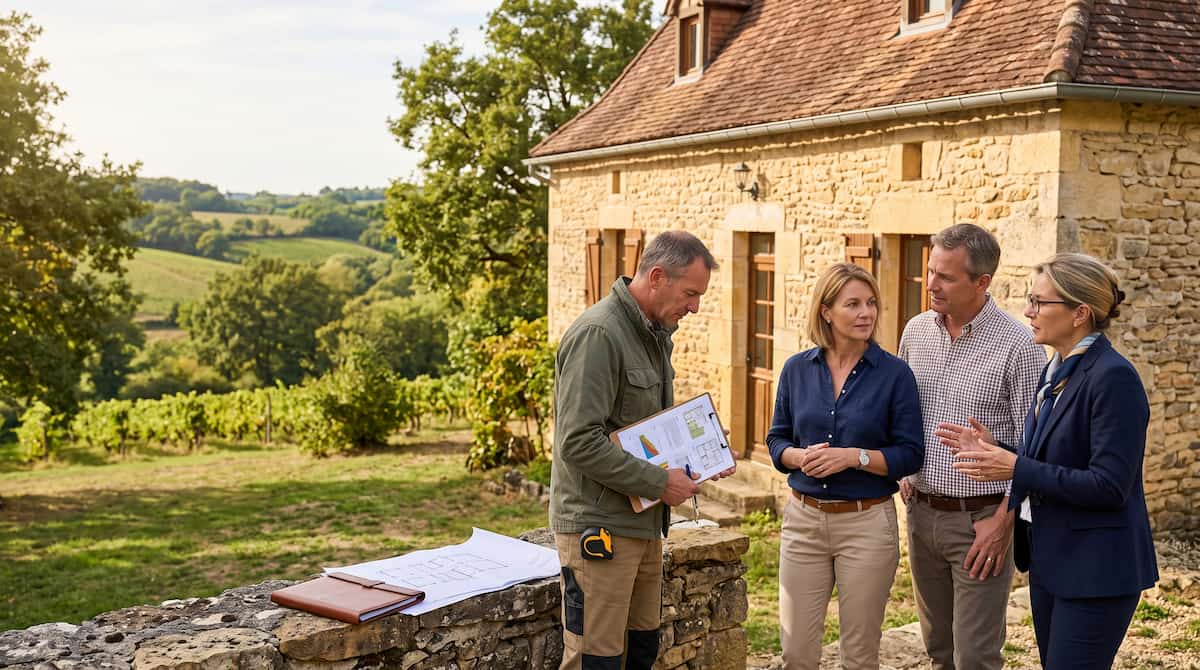
A property in rural Dordogne can present very different considerations from an apartment in central Bordeaux. A stone farmhouse, vineyard property, barn conversion or rural house may require a different network of professionals and a greater understanding of issues such as drainage, renovation, planning restrictions and traditional construction.
What if you're buying an old French property?
This is where choosing the right professional becomes particularly important.
An estate agent can help you understand the property being marketed, but they should not be treated as a substitute for independent technical or legal advice.
For example, a notaire is not a building surveyor.
A notaire plays a central role in the legal side of a French property transaction, while physical building condition may require an appropriately qualified independent professional.
Our guide to pre-purchase property surveys and notaires in France explains the distinction in more detail.
This can be particularly important when buying:
- An old stone house
- A farmhouse
- A barn conversion
- A property requiring renovation
- A house with visible cracking
- A property with damp problems
- A property with extensive outbuildings
- A property with an old roof
- A property with a septic or other non-collective sanitation system
The seller's Dossier de diagnostic technique (DDT) is important, but it isn't automatically a substitute for a comprehensive building inspection.
Don't confuse the estate agent with the notaire
One of the most common misunderstandings among international buyers is the role of the French notaire.
A notaire is a public officer who plays a central role in authenticating and securing property transactions. Their work can include title and ownership checks, legal formalities, documentation, registration and the final deed.
They are not, however, normally responsible for carrying out a comprehensive building survey.
That means a sensible property-buying team might include several different professionals:
Bilingual estate agent Helps you find and negotiate the property.
Notaire Handles the legal conveyancing and formalities.
Surveyor / building professional Assesses physical condition where appropriate.
Architect or planning professional Can advise where proposed alterations require technical or planning expertise.
Tax adviser Can advise on tax consequences where appropriate.
Your estate agent may help coordinate communication between some of these people, but you should understand each professional's role.
What about property finders or chasseurs immobiliers?
If you are buying from overseas, you may also encounter property finders, often called chasseurs immobiliers in France.
Their role can differ from that of a traditional estate agent.
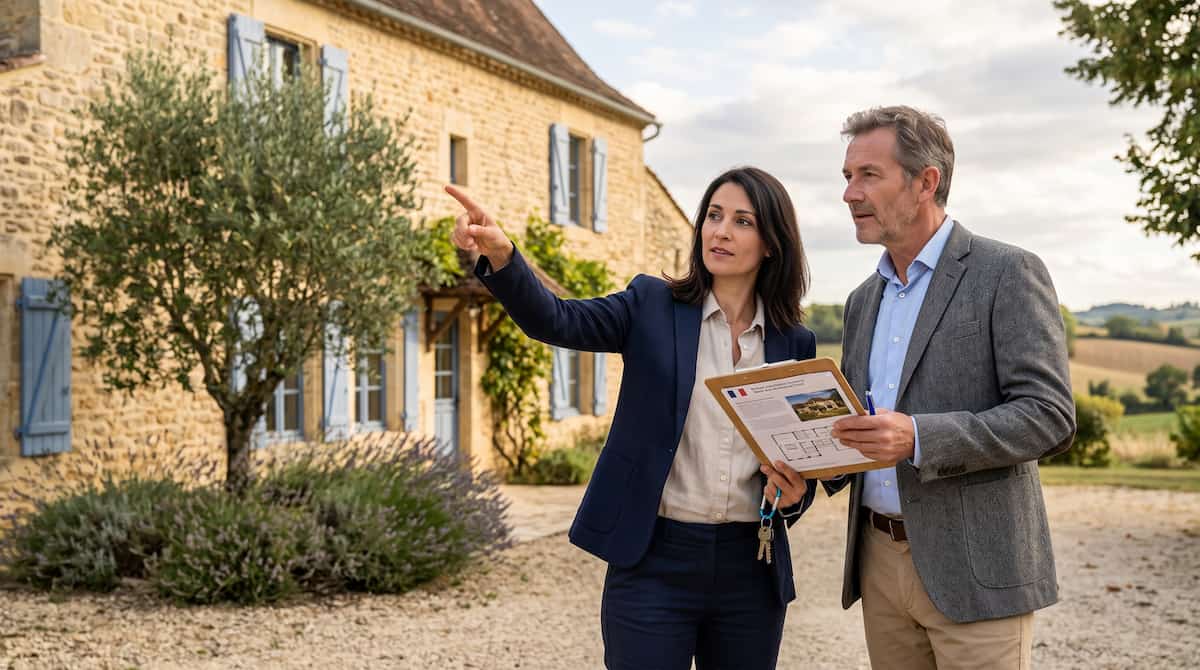
A property finder may be instructed by the buyer to search for suitable properties, arrange viewings, identify potential opportunities and sometimes assist with negotiations.
This can be particularly useful when:
- You are not living in France
- You have very specific property requirements
- You don't speak fluent French
- You don't have time to monitor the market
- You are searching across several communes
- You want someone representing your buying brief
If you are considering this type of service, ask exactly what the professional does, who pays their fees and whether they are acting for you, the seller or another party.
Understand the agency's fees
Don't leave fees until the end of the process.
Ask the agent to explain:
- The percentage or amount charged
- Who pays the agency fee
- When the fee becomes payable
- Whether the quoted property price includes agency fees
- Whether there are additional services or charges
- Whether you are signing an exclusive or non-exclusive mandate
French regulations require property professionals to provide consumers with information about their fees, and the applicable fee schedules must be displayed appropriately.
The DGCCRF also states that an estate agent must have an appropriate written mandate before carrying out the relevant intermediation or negotiation activity.
Don't be embarrassed to ask for the fee structure in writing.
Exclusive or non-exclusive mandate?
If you are selling a property, you may be asked to sign a mandat with an estate agent.
There are different types of mandates, including exclusive and non-exclusive arrangements.
Before signing, make sure you understand:
- How long the mandate lasts
- Whether it is exclusive
- How it can be cancelled
- What marketing the agency will undertake
- What commission is payable
- When commission becomes due
- Whether other agencies can also market the property
Never sign a document you don't understand simply because you are under pressure to proceed.
If necessary, ask for an independent professional to explain the legal implications.
How to find an English-speaking estate agent in Southwest France
For buyers and property owners in Southwest France, geography can be just as important as language.
VeriLocal currently covers 11 departments across Southwest France, including:
- Dordogne (24)
- Lot-et-Garonne (47)
- Gironde (33)
- Lot (46)
- Charente (16)
- Charente-Maritime (17)
- Gers (32)
- Haute-Garonne (31)
- Landes (40)
- Pyrénées-Atlantiques (64)
- Tarn-et-Garonne (82)
The VeriLocal Southwest France location directory provides an overview of the departments and local areas covered.
When choosing a property professional, don't simply search for someone who says they are "bilingual".
Look for the combination of:
Language + local knowledge + relevant experience + professional credentials.
That's a much stronger basis for choosing someone you can trust.
How VeriLocal approaches bilingual property professionals
VeriLocal is designed around the problem that international property owners often face: finding the right local professional can involve searching across multiple websites, dealing with language barriers and trying to work out which businesses are genuinely suitable.
The Immobilier & Real Estate section on VeriLocal is structured around several specialist property services, including:
- Bilingual real estate agency and sales
- Property search and expat buying agents
- Vineyard and country estate acquisitions
- Rental management and tenant sourcing
- Property valuations and certified surveys
The objective is not simply to create another list of estate agencies.
The aim is to help property owners identify specialists according to location, expertise, language and the nature of the project.
As the directory develops, this makes the service page the natural starting point for people who have read a guide such as this one and are ready to find a suitable professional.
A practical checklist for choosing a bilingual estate agent
Before instructing an agent, work through this checklist.
Language
- The agent can communicate comfortably in English
- They can explain important French terminology
- They can communicate effectively with French-speaking professionals
- You know who will handle English-language communication
Professional credentials
- The agency's business identity is clear
- SIRET/SIREN details can be checked
- Appropriate professional authorisation can be established
- Professional insurance and guarantees are understood where applicable
Experience
- The agent knows your target area
- They have experience with your type of property
- They regularly work with international clients if that matters to you
- They understand the particular challenges of rural or renovation properties where relevant
Fees and contracts
- Agency fees have been explained
- You know who pays them
- You understand the mandate
- You know whether it is exclusive
- Important terms have been provided in writing
The wider transaction
- You know which notaire will handle the transaction
- You understand whether you need an independent building inspection
- Planning issues have been investigated if your purchase depends on renovation
- Any important conditions are discussed with your notaire before signing
What are the biggest mistakes international buyers make?
Choosing an agent solely because they speak English
Language is important, but it doesn't replace professional experience.
Assuming the estate agent has checked everything
The estate agent's role is not the same as that of a notaire, surveyor, architect or tax adviser.
Signing documents you don't understand
If you don't understand a mandate or contract, get an appropriate professional to explain it before signing.
Failing to investigate renovation costs
A beautiful French farmhouse can hide substantial structural, roofing, drainage or electrical costs.
Waiting until after the compromis to investigate important issues
If your decision to buy depends on planning permission, financing or another specific condition, discuss the issue with your notaire before signing.
Our French property pre-purchase guide covers many of these issues in greater detail.
Final thoughts
Finding a bilingual estate agent in France isn't simply about finding someone who speaks English.
The best choice is a property professional who combines effective bilingual communication with local knowledge, relevant experience and appropriate professional credentials.
For international buyers, the ability to explain French property terminology and communicate with local professionals can remove a significant amount of uncertainty. But you should still maintain a clear distinction between the estate agent's role and the roles of the notaire, surveyor, architect, tax adviser and other specialists.
If you're buying or selling property in Southwest France, start by identifying exactly what kind of help you need. You may need a traditional estate agent, a property search specialist, a bilingual sales professional, a valuation expert or a combination of several specialists.
You can explore the VeriLocal Immobilier & Real Estate directory to see the property services and specialist categories available across Southwest France.
Useful official resources
For further information about the regulation of estate agents in France, see the French government's DGCCRF guidance on estate agents and the rules governing the profession: economie.gouv.fr.
For consumers considering property transactions, the official government guidance is particularly useful because it explains professional cards, mandates, insurance, guarantees and remuneration requirements.
Disclaimer: This guide provides general information and is not legal, tax, financial, structural or property advice. French property transactions can involve significant legal and financial commitments. For a specific transaction, obtain advice from the appropriate qualified professional, including your notaire where relevant.
Tell us what you need. We will find suitable local businesses.
Do not risk hiring unverified contractors. Describe your project once and receive matched introductions to up to 3 verified local businesses with checked SIRET registrations and active Décennale insurance.