
Buying a property in France can feel surprisingly different from buying a home in the UK or another country.
One of the biggest misunderstandings for international buyers is the role of the notaire.
A French notaire plays a central role in the legal side of the transaction, checking ownership, preparing the sale documents, handling searches and formalities, and completing the transfer of ownership. But a notaire is not a building surveyor.
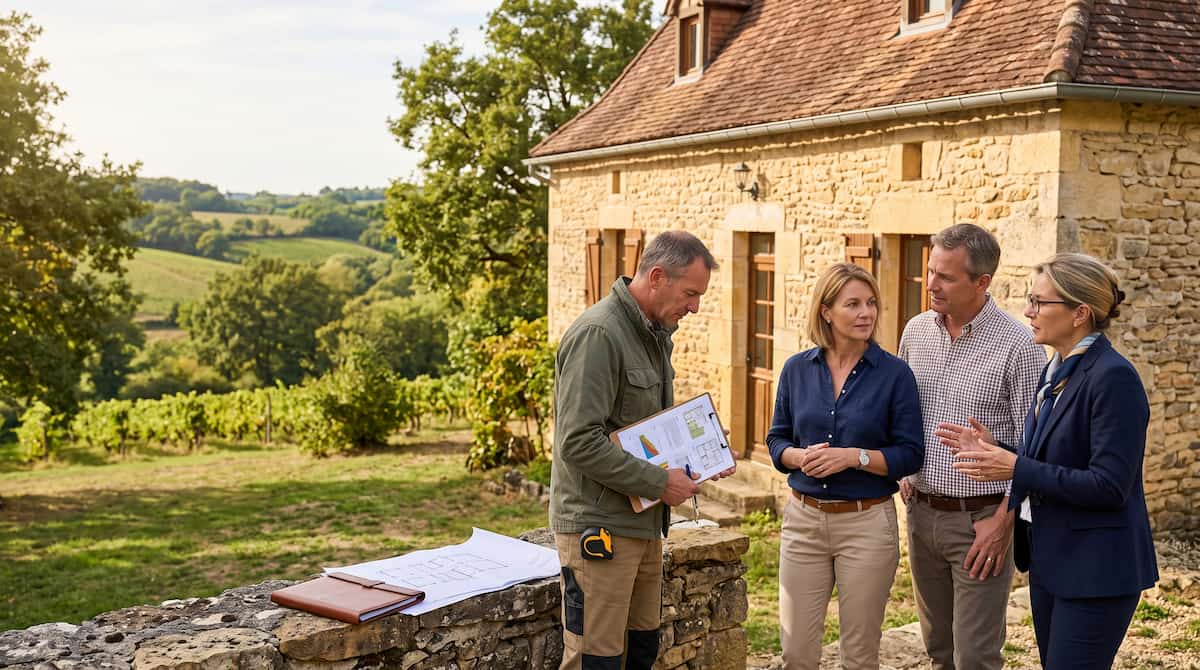
If you are buying an old farmhouse in Dordogne, a stone house in Lot-et-Garonne, or a renovation property anywhere in Southwest France, you may need a separate professional to assess the physical condition of the building before you commit to the purchase.
This guide explains what to check, who does what, and what to consider before signing the compromis de vente.
Important: This guide provides general information for property buyers in France. It is not legal, tax, structural or financial advice. For a specific purchase, speak to your notaire and appropriate qualified professionals.
The short version
Before buying a French property, think about the transaction as two separate questions:
1. Is the property legally suitable to buy?
This is where the notaire plays a central role.
They deal with matters such as:
- ownership and title
- previous transfers
- rights and restrictions affecting the property
- certain planning and legal checks
- required transaction documentation
- the sale agreement
- completion of the purchase
2. Is the property physically suitable for what I want to do with it?
This is where you may need a:
- building surveyor
- architect
- engineer
- specialist contractor
- drainage or sanitation professional
- other appropriately qualified expert
The Dossier de diagnostic technique (DDT) is important, but it is not a substitute for a full building survey.
The DDT can contain a range of legally required diagnostics relating to matters such as asbestos, lead, termites, energy performance, gas and electrical installations, and non-collective sanitation, depending on the property and its circumstances.
1. What does a French notaire actually do?
The notaire is a public officer responsible for authenticating and securing legal transactions.
For a property purchase, the notaire's work can include checking the seller's ownership, preparing the legal documentation, carrying out required searches and formalities, dealing with registration and taxes, and preparing the final acte authentique de vente.
The notaire therefore plays a vital role in making sure the legal transfer of the property is properly completed.
But that role should not be confused with a building inspection.
Your notaire is not normally there to tell you:
- whether the roof needs replacing
- whether a wall is structurally sound
- whether damp is caused by rising moisture or another problem
- whether old stone walls have been incorrectly rendered
- whether timber is affected by rot
- whether foundations need attention
- whether a renovation budget is realistic
- whether an old barn can safely be converted
- whether your proposed extension will be technically feasible
For those questions, you should consider getting independent professional advice.
2. What is the DDT?
The Dossier de diagnostic technique (DDT) is a collection of property diagnostics that the seller must provide as required by French law.
The exact contents depend on the property and its location.
Depending on the circumstances, the DDT can include information relating to:
- asbestos (amiante)
- lead (plomb / CREP)
- termites
- energy performance (DPE)
- gas installations
- electrical installations
- non-collective sanitation (assainissement non collectif)
- natural, mining and technological risks (ERP)
- noise exposure
- other legally required information
Not every property will require every diagnostic. The DDT can contain up to 12 documents under the relevant legislation.
Why the DDT matters
It gives you important information about the property and is designed to inform and protect the buyer. The seller generally has the responsibility for providing the required DDT, and the diagnostics normally form part of the documentation supplied with the preliminary sale agreement or, where applicable, the final deed.
But don't make this mistake
A DDT is not the same thing as a structural survey.
A property can have the required diagnostics and still have expensive problems that require further investigation. For an older French property, particularly one requiring renovation, consider the DDT as one part of your due diligence rather than the complete inspection.
3. When should you consider a pre-purchase survey?
A separate inspection can be particularly valuable when buying:
- an old stone property
- a farmhouse (corps de ferme)
- a barn conversion
- a property requiring substantial renovation
- a property with visible cracks
- a house showing signs of damp
- a property with an old roof
- a property with untreated timber
- a property with extensions or alterations
- a property with outbuildings
- a property where the drainage system is unclear
- a property you intend to substantially alter
It can also be worthwhile when you simply don't have enough experience to judge the condition of an older French building yourself. A relatively modest inspection cost can potentially identify problems that could otherwise become very expensive after completion.
4. What should a building survey look at?
There is no single universal "French house survey" that covers every possible issue. The scope should be agreed with the professional before the inspection.
For an older property, you may want the inspection to consider areas such as:
Structure
- Significant cracking and foundation movement
- Settlement and historical subsidence
- Structural alterations and compromised load-bearing walls (murs porteurs)
- Roof structure and timber truss conditions
Roof & Coverings
- Roof covering condition (traditional canal tiles, flat tiles, slate)
- Damaged or missing tiles and timber condition
- Evidence of water leaks and inadequate flashing
- Sagging purlins or rafters (pannes et chevrons)
Damp & Moisture Behaviour
- Penetrating damp vs. rising damp
- Condensation and ventilation deficits
- Drainage problems around footings
- Inappropriate modern materials (such as cement render applied over traditional lime-and-stone walls)
Windows, Doors & Joinery
- Condition of frames, lintels (linteaux), and shutters
- Weatherproofing and double-glazing integrity
- Evidence of structural movement around openings
Floors & Ceilings
- Uneven or bouncy timber joists (solivage)
- Moisture under ground-floor tiles or slabs
- Damaged floorboards or inappropriate past repairs
Electrical & Plumbing Systems
- Obvious safety hazards and consumer unit adequacy
- Pipework condition, pressure, and lead pipe remnants
- Don't assume an older installation is compliant just because power and water are currently connected.
Drainage & Sanitation (ANC)
- If the property is not on mains drainage, investigate the assainissement non collectif system carefully.
- Ask for the SPANC inspection report and identify what remedial works, if any, are legally required within one year of purchase.
5. Renovation properties need extra due diligence
This is particularly important in Southwest France. A property advertised as "Full of character and ready for renovation" can mean anything from a straightforward cosmetic makeover to a major structural rebuilding project.
Before buying, try to establish the real scope of work:
- Roof: Does it need isolated repair or complete timber replacement and re-tiling?
- Walls: Are cracks cosmetic or structural? Have permeable stone walls been sealed with non-breathing cement?
- Services: Where is the water supply connection? Is the electricity supply adequate for modern heating or heat pumps?
- Planning permissions: Have previous alterations been declared and approved by the mairie? Will your proposed project require a déclaration préalable or permis de construire?
6. Don't assume the notaire has approved your renovation plans
A notaire will confirm the legal status of the property, but they do not confirm that your proposed renovation is technically or architecturally feasible.
Suppose you want to:
- convert a stone barn into living accommodation
- add an extension or create new windows in an exterior wall
- install an in-ground swimming pool
- convert an outbuilding into a commercial gîte
You must investigate local planning rules (Plan Local d'Urbanisme - PLU), heritage zones (Architecte des Bâtiments de France - ABF), and sanitation capacities separately.
If your purchase depends on being able to carry out a particular project, raise that issue before signing the compromis de vente.
7. What is a compromis de vente?
The compromis de vente is the preliminary contract in which the buyer and seller commit to completing the transaction on agreed terms.
Under French law, a compromis is a legally binding contract. For a non-professional residential buyer, there is a 10-day statutory withdrawal period (délai de rétractation) after formal notification of the signed agreement. However, that should not be used as an excuse to sign first and investigate later.
8. Conditions suspensives: don't overlook them
A condition suspensive makes the completion of the sale dependent on a specified event occurring. If the condition is not met without fault on your part, the contract is cancelled and your deposit is refunded.
Common examples include:
- Obtaining mortgage financing on specified terms
- Obtaining a satisfactory planning certificate or building permit (permis de construire)
- Non-exercise of statutory pre-emption rights by the local commune or SAFER
- Absence of serious legal easements or restrictive covenants
If your decision to buy depends on something specific (e.g. "We will only purchase if we can legally convert the barn into a dwelling"), instruct your notaire to draft an appropriate condition suspensive.
9. If you need a mortgage
If you are using mortgage financing, the preliminary contract will include a statutory financing condition. Ensure that the loan amount, interest rate, term, and lender criteria specified in the contract accurately reflect your borrowing requirements.
10. Questions to ask before signing the compromis
About the property
- Who legally owns the title? Are all outbuildings and land parcels clearly identified on the cadastre?
- Are there rights of way, shared driveways, or agricultural easements?
- Are there ongoing boundary disputes or neighbour claims?
About the diagnostics
- Have I received the complete DDT? Are any diagnostics expired?
- Does the sanitation diagnostic require a total system replacement?
About the building & renovation
- Have I had an independent inspection of structural elements and roof timbers?
- What are the estimated major renovation costs, including a 15 to 20% contingency?
- Are our intended modifications permitted under the local PLU?
11. What should you ask the seller?
- Previous work: What renovations were done, when, and by which registered artisans? Are invoices and décennale insurance certificates available?
- Structural history: Has the building suffered historical movement, flooding, or persistent damp?
- Septic tank: When was the system last emptied and inspected by SPANC?
Don't rely solely on verbal reassurances. Where an item is critical, request written documentation.
12. Get renovation quotes before you buy when possible
If buying a renovation project, assemble realistic contractor quotes for the major structural items before committing:
- Roof covering and timber structure
- Structural repairs and pointing
- Damp remediation and drainage
- Windows, doors, and lintels
- Electrical rewire to NF C 15-100 standards
- Plumbing and heating systems
- Non-collective sanitation installation (fosse / micro-station)
- Insulation and internal partitions
Always include a healthy contingency budget for unexpected findings in traditional stone properties.
13. Should you use your own notaire?
In France, buyers and sellers can each appoint their own notaire. Using two notaires does not increase the overall notary fees; the regulated statutory fee is divided between them.
Having your own notaire ensures you have an independent legal professional representing your interests as the buyer and explaining complex French legal nuances.
14. Practical Pre-Purchase Checklist
Legal & Administrative
- Confirm legal title and cadastral boundaries
- Verify what buildings and fixtures are included
- Check easements, rights of way, and SAFER rights
- Review preliminary contract and conditions suspensives
- Confirm financing condition details
Statutory Diagnostics (DDT)
- Complete DDT received and reviewed
- DPE energy rating and recommendations checked
- Termite, lead, and asbestos reports checked
- SPANC sanitation report and remedial requirements noted
Physical & Structural Condition
- Roof timbers (charpente) and covering inspected
- Walls checked for structural movement and inappropriate cement render
- Damp causes identified (rising, penetrating, or condensation)
- Electrical and plumbing installations evaluated
Renovation & Planning
- Local planning rules (PLU) and heritage zones (ABF) checked
- Major works quotes and budget calculated with contingency
- Planning condition suspensive included if purchase depends on permissions
15. The biggest mistake international buyers make
The most common trap is assuming that because a notaire is handling the transaction, the physical condition and renovation suitability of the building have been verified.
The notaire secures the legal transfer. An independent building surveyor or qualified specialist assesses the physical reality. Both are essential parts of smart property buying in France.
Find Property Specialists & Artisans in Southwest France
If you are purchasing a property in Dordogne, Lot-et-Garonne, Gironde, Charente, or the wider Southwest, VeriLocal connects you with verified local professionals:
- Find Property Surveyors & Diagnostic Specialists
- Find English-Speaking Artisans & Builders
- Request Quotes for Renovation Projects
VeriLocal does not provide formal legal or structural advice. Always verify technical details and contractual terms with your notaire and qualified professionals.
Tell us what you need. We will find suitable local businesses.
Do not risk hiring unverified contractors. Describe your project once and receive matched introductions to up to 3 verified local businesses with checked SIRET registrations and active Décennale insurance.