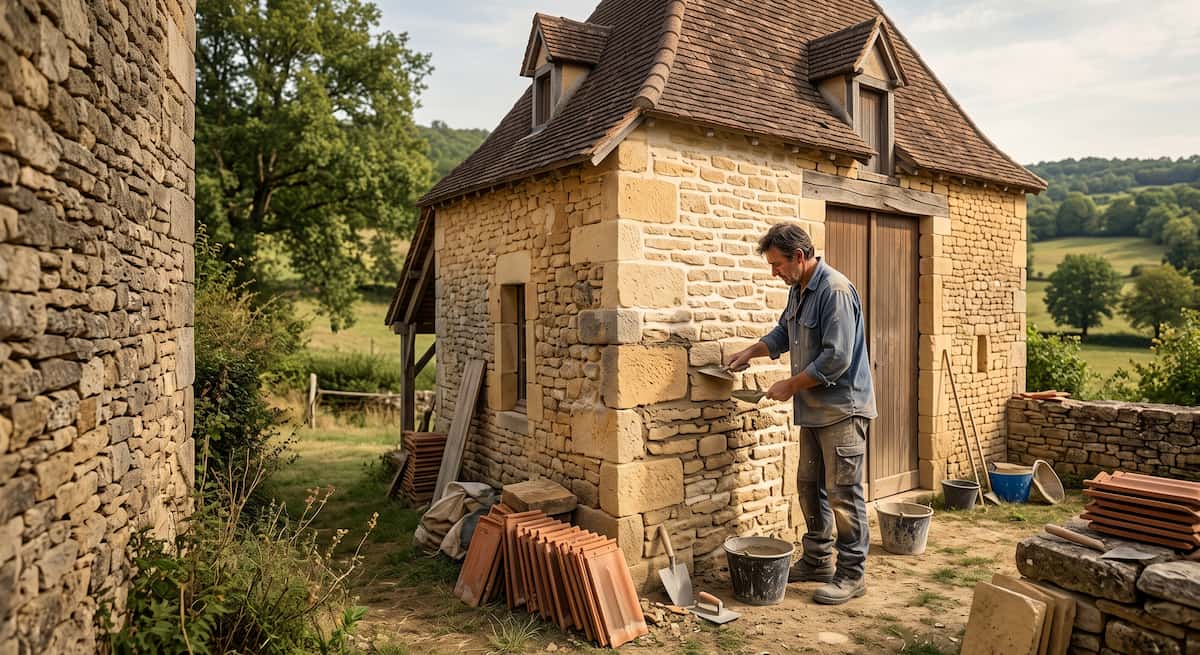

Falling in love with a secluded stone farmhouse, an old wine-grower's cottage, or a village bastide home in the Dordogne is an intoxicating experience. The Périgord countryside offers tranquil valleys, oak woodlands, and exceptional character properties at prices often unthinkable in southern England, northern Europe, or metropolitan France.
However, buying a rural property in France carries distinct legal, environmental, and infrastructure responsibilities. Rural properties operate on private drainage, border agricultural land, and frequently involve centuries-old legal rights of way.
Before you sign the binding bilateral sales contract (Compromis de Vente or Promesse de Vente), work through this rigorous pre-purchase checklist to understand exactly what you are acquiring.
1. Sanitation: The Critical SPANC Inspection (Assainissement Non Collectif)
The majority of rural Dordogne homes are not connected to mains drainage (tout-à-l'égout). They rely on autonomous, on-site sanitation systems (assainissement non collectif or ANC), commonly referred to as a fosse septique.
Under French law, the seller must provide an official inspection report carried out within the last three years by the local public drainage authority: the SPANC (Service Public d'Assainissement Non Collectif).
Understanding the SPANC Diagnostic
- Conforme: The system satisfies current environmental and public health standards.
- Non-conforme: The system has defects, is undersized, discharges improperly, or lacks an approved filtration bed.
- Absence d'installation: Older properties may feature little more than an archaic cesspit or direct pipe (fosse perdue), which is strictly illegal under French environmental law.
Financial Implications
Installing a modern compliant sanitation system, such as a certified compact filter (filtre compact), micro-station (micro-station d'épuration), or traditional sand filter (filtre à sable), typically costs between €8,000 and €16,000+. On steep, rocky, or clay-heavy Périgord plots, excavation costs and required soil percolation studies (étude de filière) can increase this figure. Use a non-compliant SPANC report to negotiate the purchase price before signing.
2. Servitudes: Rights of Way, Utilities & Rural Access
Rural properties in Southwest France frequently carry legal easements (servitudes), either benefiting the land (active) or burdening it (passive).
Key Easements to Inspect:
- Rights of Way (Servitudes de Passage): Does a farmer, neighbour, or forestry worker have the legal right to drive vehicles or machinery across your driveway to reach adjoining land? Conversely, does your property have an irrevocable, notarised right of way to access the public road (désenclavement)?
- Agricultural Tracks (Chemins d'Exploitation): Rural properties often border private shared tracks created for agricultural access. All bordering owners share the right to use the track and the legal obligation to contribute to its maintenance.
- Utility Easements (Servitudes de Tréfonds et Trépassants): Check for subterranean water conduits or overhead high-voltage electricity lines managed by Enedis.
- Communal Hunting Rights (ACCA): In rural France, municipal hunting associations (Association Communale de Chasse Agréée) automatically hold hunting rights across private land unless the owner has filed a formal legal objection (droit d'opposition) on moral grounds under the French Environmental Code.
Always require your notaire to extract and detail all recorded servitudes from the historic title deeds before you sign the compromis.
3. Town Planning, Zoning & Building Permissions (PLU & ABF)
Never assume you can build a swimming pool, convert an outbuilding, or add a terrace without statutory local authorization.
The Commune's Planning Document (PLU or Carte Communale)
Ask the local Mairie (town hall) for a planning certificate (Certificat d'Urbanisme d'Information - CUa) or operational certificate (CUb). Check the zoning:
- Zone U (Urbanisé): Building is generally permitted, subject to municipal building regulations.
- Zone AU (À Urbaniser): Future development zone, often subject to infrastructure completion.
- Zone A (Agricole): Strictly reserved for agricultural activity. Converting barns or expanding residential footprint is heavily restricted.
- Zone N (Naturel): Protected countryside. New construction is virtually prohibited; renovations are restricted to preserving existing footprints.
Converting Outbuildings: The "Destination" Trap
An old stone barn, wine store (chais), or tobacco shed (séchoir à tabac) does not automatically possess residential status. Converting an outbuilding into a gîte requires a formal Changement de Destination approved via a Déclaration Préalable or Permis de Construire. If the property lies in Zone A or N, the local planning department can legally refuse the conversion.
The Architectes des Bâtiments de France (ABF)
Dordogne has hundreds of registered historic monuments (châteaux, abbayes, bastides). If your property sits within 500 metres of a historic monument or within a Site Patrimonial Remarquable, all exterior alterations fall under the oversight of the state heritage architect (ABF).
- PVC window frames and shutters are routinely banned; painted timber joinery is mandatory.
- Specific roof pitches, terracotta tiles (tuiles plates or tuiles canal), and traditional lime-based renders (chaux) are legally enforced.
4. Land Boundaries: The Cadastre vs. Formal Survey (Bornage)
One of the most widespread misconceptions among international buyers is that the French tax map (Le Cadastre) defines legal property boundaries.
The Cadastre is solely a fiscal document. It indicates the approximate surface area for property tax (taxe foncière) calculations. It does not establish legally binding boundary lines.
- If boundaries are ambiguous, unfenced, or disputed, request a formal boundary demarcation (bornage contradictoire) carried out by an independent registered land surveyor (géomètre-expert).
- Confirm whether adjoining farmland is currently leased to a tenant farmer (bail rural). Registered agricultural leases give French tenant farmers strong statutory tenure rights and statutory pre-emption rights through SAFER.
5. Stone, Roofs, and Moisture: Périgord Building Realities
Historic Périgord properties were built using local limestone joined with earth, sand, and lime mortar. They do not possess modern damp-proof courses, concrete floor slabs, or cavity wall insulation.
- Natural Vapour Permeability: Stone walls must breathe. Beware properties where previous owners applied hard Portland cement renders or interior waterproof coatings, which trap moisture and trigger wall decay. Read our detailed guide on Renovating a Traditional Stone Farmhouse in Dordogne.
- Roof Trusses & Woodworm: Inspect roof timbers for signs of active wood-boring insects (capricornes des maisons, vrillettes). While the statutory pre-sale diagnostic includes a termite report (état parasitaire), it frequently excludes non-termite woodborers unless specifically requested.
- Pre-Purchase Surveys: Unlike the UK, French home purchases do not standardly involve a comprehensive structural survey. Consider engaging an independent chartered surveyor (RICS) or experienced bilingual French architect before unconditional exchange. Review our advice in Pre-Purchase Property Surveys & Notaires in France.
6. Pre-Signing Checklist: What You Can Check vs. What Requires a Professional
| Task / Item | Can Check Yourself? | Requires Qualified Professional? |
|---|---|---|
| Inspect SPANC Septic Report | Read diagnostic summary | Drainage engineer / SPANC technician for upgrade devis |
| Verify Mobile & Broadband Signal | Test 4G/5G on phone; verify fibre status via ARCEP map | Network provider for connection work |
| Check Title Deeds & Servitudes | Review drafts from agent | Notaire to audit Land Registry (Publicité Foncière) |
| Check Planning & Zoning (PLU) | Consult map at the local Mairie | Architect / Maître d'œuvre for planning feasibility |
| Establish Exact Legal Boundaries | Check visible markers / fences | Géomètre-expert for formal bornage |
| Verify Structural Integrity & Roof | Visual inspection of beams and damp | Independent building surveyor / expert en bâtiment |
| Check Electrician & Builder Quotes | Compare line-by-line pricing | Artisan with verified SIRET & Garantie Décennale |
Essential Next Steps Before Signing Your Compromis de Vente
- Insert Suspensive Conditions (Conditions Suspensives): If your purchase depends on obtaining planning approval (permis de construire), obtaining a mortgage, or receiving acceptable soil tests for a septic tank, instruct your notaire to include specific suspensive clauses in the compromis.
- Review the Full DDT Dossier: Ensure you have received all mandatory diagnostics (asbestos, lead, electricity, gas, DPE energy audit, termites, and ERP environmental risks).
- Connect With Verified Local Specialists: Before committing, obtain preliminary quotes from registered French artisans to verify your renovation and compliance budget:
Tell us what you need. We will find suitable local businesses.
Do not risk hiring unverified contractors. Describe your project once and receive matched introductions to up to 3 verified local businesses with checked SIRET registrations and active Décennale insurance.