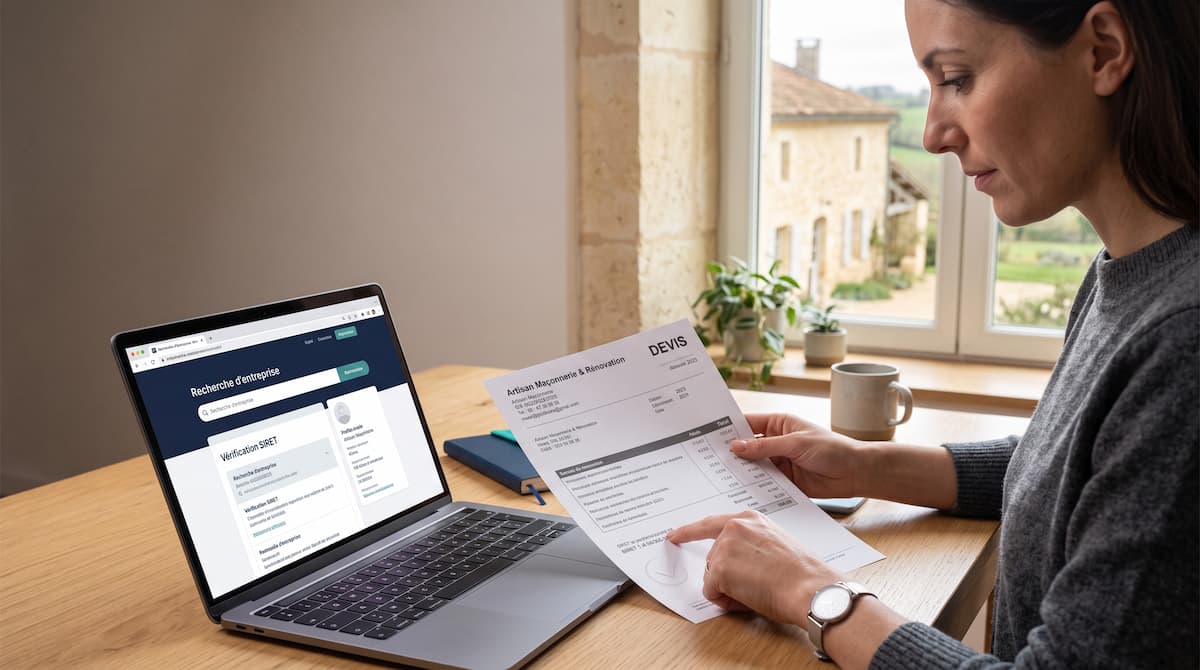
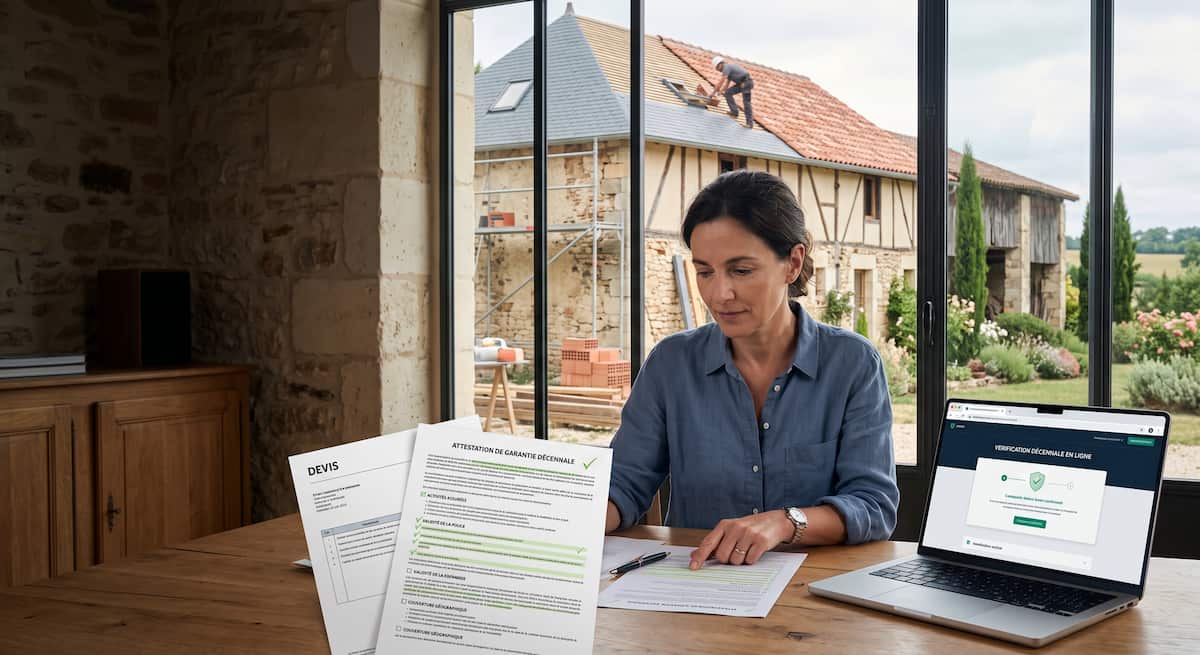
If you are hiring a builder, roofer, mason, plumber or other construction professional in France, checking their Garantie Décennale should be part of your due diligence before work begins.
Décennale insurance is not simply a badge that says an artisan is "insured". The important questions are:
- Is the policy valid when your work starts?
- Does the insurance cover the actual work being carried out?
- Does the name and business identification match the contractor you are hiring?
- Is the geographical scope appropriate?
- Can the contractor provide a proper insurance certificate (attestation d'assurance)?
Getting these details wrong can leave a property owner facing a difficult insurance claim when something goes seriously wrong.
What Is Garantie Décennale in France?
The Garantie Décennale, more precisely the contractor's assurance de responsabilité civile décennale, is a form of compulsory professional insurance for construction professionals whose work falls within the French décennale liability regime.
Under Article 1792 of the French Civil Code, a constructeur can be held responsible for damage that compromises the solidity of the work or makes it unsuitable for its intended purpose. The regime also extends to certain defects affecting elements of equipment that are inseparable from the building.
The corresponding insurance obligation is set out in Article L241-1 of the French Insurance Code. A professional whose décennale liability can be engaged must be insured and must be able to justify that insurance when the site opens.
The system was introduced as part of the major construction insurance reforms associated with the Loi Spinetta of 4 January 1978.
The important point for property owners
Décennale does not mean that every defect for the next ten years is automatically covered.
It is designed for particular types of serious construction damage, and the insurance only covers work and activities falling within the scope of the contractor's policy.
That distinction is crucial when checking an artisan's insurance certificate.
How Long Does Garantie Décennale Last?
The contractor's décennale liability generally applies for 10 years from the day after formal acceptance of the works (réception des travaux).
The réception is the point at which the owner accepts the completed works, with or without reservations.
This is different from the period during which the contractor's insurance policy must be active.
For example, if a contractor carries out work under a valid décennale policy and the project is formally received, qualifying defects appearing during the following ten-year period may fall within the décennale regime.
For property owners, this is why it is important to keep:
- the signed contract or devis
- the contractor's insurance certificate
- invoices
- photographs of the work
- correspondence
- and, where applicable, the procès-verbal de réception.
What Does Décennale Actually Cover?
The key test is not simply whether the work was expensive or "major".
The décennale regime concerns serious defects that fall within Article 1792 and related provisions of the Civil Code.
This can include damage that:
- compromises the structural solidity of the building;
- makes the building or part of it unfit for its intended purpose;
- affects certain inseparable elements of equipment;
- or concerns other works falling within the statutory construction regime.
Examples given by Service-Public include foundations and structural works, certain networks and drainage works, structures with foundations such as an in-ground swimming pool, and inseparable equipment such as embedded pipework, central heating and fixed electrical installations.
Examples of work that may fall within the décennale regime
| Work | Potential décennale relevance |
|---|---|
| Foundations and structural masonry | Yes |
| Structural roof work | Yes, where the statutory conditions are met |
| Waterproofing affecting the building | Potentially |
| In-ground swimming pool with foundations | Potentially |
| Embedded plumbing or heating systems | Potentially |
| Embedded electrical installations | Potentially |
| Structural extension work | Yes, where the statutory conditions are met |
| Decorative painting | Generally not décennale simply because it forms part of a renovation |
| Decorative wall coverings | Generally outside décennale |
| Freestanding furniture or fixtures | Generally outside décennale |
The exact answer depends on the nature of the work, how it is incorporated into the building and the applicable insurance contract.
Do not assume that an artisan's Décennale certificate covers every service they offer.
Décennale vs Biennale vs RC Pro
One common mistake is to treat Décennale as a general-purpose warranty covering every problem after a renovation.
French construction law provides several different forms of protection.
Garantie décennale
Generally concerns serious damage affecting the structure, the intended use of the building, or certain inseparable equipment.
Duration: 10 years from reception of the works.
Garantie de bon fonctionnement: the biennial guarantee
Certain equipment elements that can be removed without damaging the building may fall under the two-year guarantee (garantie de bon fonctionnement) rather than the décennale regime.
Duration: generally 2 years from reception.
Responsabilité Civile Professionnelle: RC Pro
RC Pro is different again. It can cover certain damage caused in the course of a professional's activities, including circumstances that do not fall within the décennale regime.
The fact that a contractor has RC Pro therefore does not mean they have the construction insurance required for work subject to décennale liability.
For substantial building work, check the actual décennale certificate rather than simply asking whether the contractor is "insured".
6 Things to Check on an Attestation Décennale
Before allowing work covered by the décennale regime to begin, ask the contractor for their current Attestation d'Assurance de Responsabilité Décennale.
French insurance rules specify information that must appear on the relevant attestation, including the insured's identity, identification number, insurer, policy number and validity period. Depending on the certificate, it can also specify the activities, geographical scope and characteristics of the construction operation.
Here is what you should actually check.
1. The Contractor's Legal Identity
The name of the insured business on the insurance certificate should correspond with the business you are contracting with.
Check:
- legal/business name
- address
- SIRET or other unique identification number shown on the certificate
- the identity shown on your devis and contract.
If these details do not match, stop and ask the contractor to explain the discrepancy before work starts.
A valid-looking certificate belonging to a different company is not sufficient.
2. The Policy Number and Insurer
The certificate should identify the insurance company and the relevant policy or contract number.
You do not need to choose a contractor simply because they use a particular well-known insurer.
What matters is whether the contractor has appropriate insurance and whether the certificate relates to that contractor and that work.
If you have doubts about a certificate, contact the insurer using independently obtained contact details rather than relying solely on a telephone number supplied on an unfamiliar document.
3. The Validity Period
Check the Période de validité shown on the certificate.
The important question is whether the insurance covers the relevant work at the time the construction site opens.
French law requires the professional to be able to justify décennale insurance at the opening of the site, and Service-Public states that the insurance applies only to works for which the site opened during the period of validity of the contract.
Do not assume that an old certificate is still valid simply because the contractor says they have renewed their insurance.
Ask for the current certificate covering the start of your project.
4. The Activities Actually Covered
This is one of the most important checks.
A contractor may have décennale insurance while the policy only covers particular activities.
For example, a contractor may have insurance covering certain masonry or plastering activities but not every type of roofing, structural timber or waterproofing work.
The certificate should therefore be compared against the actual work described in your devis.
Look for the relevant wording under sections such as:
- Activités garanties
- Activités professionnelles garanties
- Nature des travaux
- Travaux, produits et procédés de construction
The official model for décennale attestations requires the scope of cover to be described according to the activities or missions performed and, where applicable, other characteristics of the construction work.
This is the check that matters most: Do not ask "Does this artisan have Décennale?" Ask: "Does this artisan's Décennale cover the work I am paying them to carry out?"
5. The Geographical Scope
Check the Étendue géographique or equivalent geographical information on the certificate.
For work being carried out in France, the policy must provide the appropriate geographical cover for the project.
This is particularly important when dealing with:
- contractors based outside France;
- businesses that regularly work across borders;
- contractors whose insurance documentation relates to another country.
A contractor working in France must have insurance that covers their French décennale liability for contracts performed in France.
6. Compare the Certificate With the Devis
Finally, compare the insurance certificate directly against the quotation.
Look at:
- Who is doing the work? Does the insured identity match?
- What are they doing? Does the insured activity correspond to the work described?
- Where is the work? Does the geographical scope cover the project?
- When does the work start? Is the policy valid when the site opens?
This simple comparison is much more useful than simply seeing a Décennale logo or insurer name on a document.
What If the Contractor's Décennale Does Not Match the Work?
Do not ignore a mismatch.
For example, imagine your devis includes:
Réfection complète de toiture avec remplacement de la charpente
but the insurance certificate only lists activities unrelated to structural roofing.
That is a reason to stop and obtain clarification.
The contractor may have:
- supplied the wrong certificate;
- recently expanded their insured activities;
- changed insurance companies;
- subcontracted part of the work;
- or simply be proposing work outside their declared insurance scope.
Ask the contractor to provide confirmation from their insurer that the specific activity is insured before work begins.
Remember that the insurance certificate is evidence of insurance; it is not a substitute for reading the scope of the policy.
What About Subcontractors?
This is another area where property owners can become confused.
The contractor you hire may subcontract some of the work to another company or artisan.
The legal and insurance relationship can then become more complicated.
Service-Public notes that subcontractors do not fall within the statutory décennale regime in the same way as a contractor directly linked to the maître d'ouvrage, although they remain responsible for obligations towards the contractor who engaged them.
If a substantial part of your project is being subcontracted, ask the principal contractor:
- who will actually carry out the work;
- which activities are being subcontracted;
- and what insurance arrangements apply.
For significant projects, it is sensible to keep documentation identifying the businesses involved in the work.
Don't Confuse Décennale With Dommages-Ouvrage
Property owners should also know about assurance dommages-ouvrage.
This is separate from the contractor's décennale insurance.
The contractor's décennale insurance protects against the contractor's relevant décennale liability.
Dommages-ouvrage insurance is designed to allow qualifying repair costs to be advanced without first having to establish which construction professional is responsible. Service-Public explains that the maître d'ouvrage is generally required to take out this insurance for covered construction work.
This distinction matters because a property owner undertaking a significant extension, structural renovation or new construction should not assume that obtaining every contractor's Décennale certificate removes the need to consider dommages-ouvrage.
For a substantial project, this is something to discuss with your insurer or appropriately qualified professional before work begins.
What Happens If the Builder Goes Out of Business?
A contractor closing their business after completing the work does not automatically make the décennale protection disappear.
Service-Public specifically states that the contractor's bankruptcy does not itself affect the décennale guarantee. The insurer's details can be found on the insurance certificate, and the relevant insurer can therefore remain important when pursuing a qualifying claim.
This is one reason you should keep the original insurance certificate with your property records.
If you later sell the property, these documents can also be valuable to the next owner.
When Does the 10-Year Period Start?
The décennale period is linked to the reception of the works, not simply the date on the contractor's final invoice.
Under Article 1792-6 of the Civil Code, réception is the act by which the maître d'ouvrage accepts the work, with or without reservations.
The ten-year period then runs from the day following the reception.
For that reason, keep a formal record of the reception date and any reservations concerning unfinished or defective work.
A Practical Décennale Checklist for Property Owners
Before a construction project starts, check:
Contractor
- Legal/business identity matches the contract
- SIRET/SIREN information is consistent
- Contractor is properly identified on the devis
Insurance
- Current décennale certificate supplied
- Insurer identified
- Policy/contract number present
- Validity period covers the project start
- Geographical scope is appropriate
- Insured activities correspond to the actual work
Project
- Written devis clearly describes the work
- Any subcontractors are identified
- Important project documents are retained
- Reception of works is formally documented
- Dommages-ouvrage requirements have been considered for substantial works
If any of these checks fail, resolve the issue before work starts rather than trying to sort it out after something goes wrong.
How VeriLocal Handles Décennale Verification
At VeriLocal, insurance is treated as part of the wider verification process rather than as a simple marketing badge.
For eligible construction and renovation businesses, VeriLocal can use insurance documentation alongside business registration information and other verification checks when assessing a business profile.
The aim is to make it easier for property owners to identify businesses that have provided evidence of relevant insurance and registration information.
However, a verification badge should never be interpreted as a guarantee that every possible defect, service or project is covered by an artisan's insurance.
Always check the contractor's current documentation and make sure the insured activities correspond to the work you are commissioning.
Final takeaway
A Décennale certificate should not be treated as a piece of paperwork to collect and file away without reading.
Before hiring a French construction professional, check that:
the business is the business you think you are hiring, the insurance is current, and the insurance actually covers the work you are paying them to perform.
That three-part check can make a significant difference if a serious construction defect appears years after the project has been completed.
For substantial building or renovation projects, consider taking the same approach with SIRET verification, insurance, the devis, qualifications and project documentation.
Tell us what you need. We will find suitable local businesses.
Do not risk hiring unverified contractors. Describe your project once and receive matched introductions to up to 3 verified local businesses with checked SIRET registrations and active Décennale insurance.