
Lot-et-Garonne (47) has a distinctive geography: punctuated by bustling market towns along the Garonne and Lot river corridors, surrounded by rolling hills, bastide villages, and expansive agricultural communes.
For homeowners with a property situated in rural areas between Duras, Marmande, Agen, and Villeneuve-sur-Lot, securing reliable, qualified tradespeople requires an understanding of how local trade networks operate across rural Southwest France.
Whether you need a structural mason to assess clay soil movement, a roofer for a traditional bastide property, or a bilingual plumber for a holiday rental, this guide explains how to identify, evaluate, and collaborate with verified local trades across the department.
1. Geographic Hubs & Trade Availability in Lot-et-Garonne
Contractor availability and specialisms vary noticeably across Lot-et-Garonne's distinct micro-regions:
The Pays de Duras & The Dropt Valley (Duras, Allemans, Lévignac)
Situated at the tri-point where Lot-et-Garonne meets Gironde and Dordogne, Duras has a well-established international community. Here you will find a strong network of bilingual French artisans, registered British-born contractors, and property managers. Trades in this zone regularly cross departmental borders into Sainte-Foy-la-Grande and Eymet.
The Val de Garonne (Marmande, Tonneins)
The central spine of the department. Marmande is a major commercial hub with established builders' merchants, electrical wholesalers, and specialized civil engineering contractors (entreprises de terrassement). Availability is strong, but tradespeople are predominantly French-speaking.
Greater Agen (Agen, Le Passage, Bon-Encontre, Nérac)
As the administrative prefecture, Agen possesses the highest concentration of specialist commercial trades: HVAC and heat pump specialists (chauffagistes RGE), structural engineering firms (bureaux d'études), and heritage decorators. Trades based here readily cover the southern half of the department and into northern Gers (32).
The Lot Valley & Haut-Agenais (Villeneuve-sur-Lot, Monflanquin, Villeréal)
A rich architectural territory with medieval bastides and rural stone properties. Artisans here frequently specialize in stone masonry, half-timbering (colombages), lime renders, and bespoke timber joinery.
2. Essential French Terminology for Hiring Trades
Knowing the correct French job titles ensures you contact the right specialist for your project:
| Trade (English) | French Term | Scope of Work & Regulatory Checks |
|---|---|---|
| General Builder / Mason | Maçon / Entreprise de Maçonnerie | Structural walls, stone pointing, foundations, concrete slabs. Mandatory Garantie Décennale. |
| Roofer & Zinc Worker | Couvreur-Zingueur | Roof timbers, tile replacement, zinc valleys, flashing, gutters. Mandatory Garantie Décennale. |
| Carpenter / Framer | Charpentier | Structural roof trusses, floor joists, bastide timber framing (colombages). Mandatory Décennale. |
| Electrician | Électricien | Consumer units, wiring to French standard NF C 15-100, earthing, certificate of compliance (Consuel). |
| Plumber / Heating Engineer | Plombier-Chauffagiste | Pipework, sanitary drainage, boilers, heat pumps (PAC). Look for RGE accreditation for heating. |
| Groundworker / Earthmover | Terrassier | Excavation, drainage ditches, foundations, septic installations (assainissement non collectif). |
| Joiner / Cabinetmaker | Menuisier | Windows, shutters (volets), exterior doors, staircases, heritage timber replication. |
| Project Manager | Maître d'Œuvre / Architecte | Independent project design, planning permissions, contractor coordination, and site supervision. |
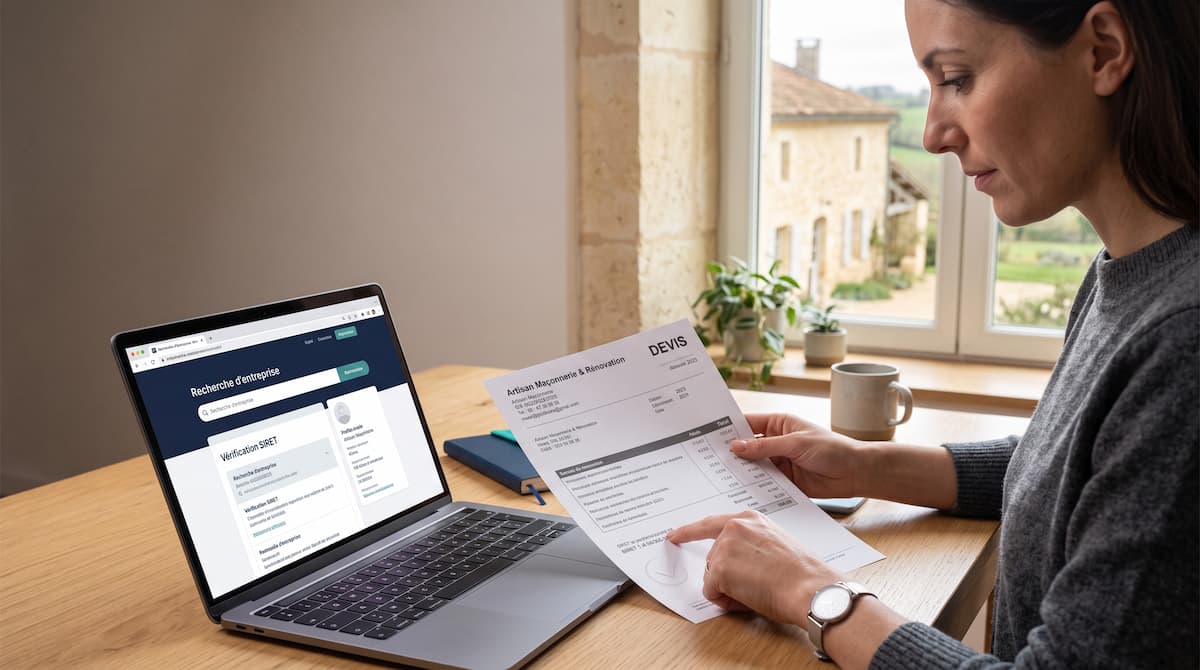
3. The 3 Statutory Checks Before Signing Any Devis
In France, consumer protection laws are strict, but the burden of verification rests with the property owner. Before signing any contract (devis), verify these three credentials:
A. The 14-Digit SIRET Number
Every legally registered business operating in France has an active SIRET registration on the national business register.
- Confirm that the contractor's registered trade activity code (Code APE/NAF) matches the work being performed (e.g., Code 43.99C for masonry, 43.22A for plumbing).
- Learn how to verify registration status: How to Check a French Artisan's SIRET Number.
B. Active Garantie Décennale Insurance
Under Article 1792 of the French Civil Code, all structural and building envelope works carry mandatory 10-year defect insurance.
- Request a copy of the artisan's Attestation d'Assurance Décennale before work begins.
- Verify that the insurance policy is current for the site start date and explicitly lists the geographical coverage (France) and relevant activity.
- Read our guide: Garantie Décennale in France: What Property Owners Must Check.
C. Formal Written Devis (Quote)
Under French commercial law, a verbal estimate or simple text message carries no legal validity. An official devis must include:
- Full company name, registered address, and SIRET number.
- Details of the decennial insurance provider and contract number.
- Itemized line-by-line description of labor, materials, and quantities.
- Clear payment schedule (e.g., 30% deposit on signature, interim progress payments, final balance on completion).
- Explore our tutorial: Understanding a French Devis: What Must Be Included by Law.
4. How to Request Quotes & Avoid Delays
In-demand artisans in Lot-et-Garonne are frequently booked several months in advance. To secure prompt, detailed responses:
- Prepare a Comprehensive Project Brief: Write a short bullet-point summary of what you want to achieve, broken down room-by-room.
- Provide Visual Evidence: Include high-resolution photos of the work area, structural details, and utility connections (water meter, main electrical board).
- Clarify Site Access Constraints: If your rural property is accessed via a narrow bastide archway, a steep gravel slope, or an unpaved agricultural track (chemin d'exploitation), notify contractors in advance so they can plan appropriate vehicle sizes.
- Compare at Least Two Detailed Quotes: Never compare purely on the bottom-line total. Scrutinize the quality of specified materials (e.g. natural hydraulic lime vs. cement blends; copper vs. multilayer PEX piping).
5. The Dangerous Trap of "Au Noir" (Cash in Hand)
Because rural Southwest France has an international community, unregistered individuals occasionally offer building, plumbing, or electrical services "off the books" (au noir).
While having an informal arrangement for light garden mowing may seem harmless, using unregistered contractors for building, electrical, or plumbing work carries catastrophic risks:
- Insurance Invalidation: In the event of a house fire from faulty wiring, a water leak inside stone masonry, or a collapsed roof truss, your building insurance will demand certified invoices. Without valid proof of registered work, the insurer can legally reject your claim.
- Zero 10-Year Warranty: You have no legal recourse under French law if structural faults or water leaks appear post-completion.
- Resale Deadlock: When you sell your home, the notaire demands invoices and decennial insurance certificates for structural works undertaken in the preceding 10 years. Without them, you remain personally liable to the buyer for latent defects (vices cachés).
Related Regional Guides & Resources
Tell us what you need. We will find suitable local businesses.
Do not risk hiring unverified contractors. Describe your project once and receive matched introductions to up to 3 verified local businesses with checked SIRET registrations and active Décennale insurance.