
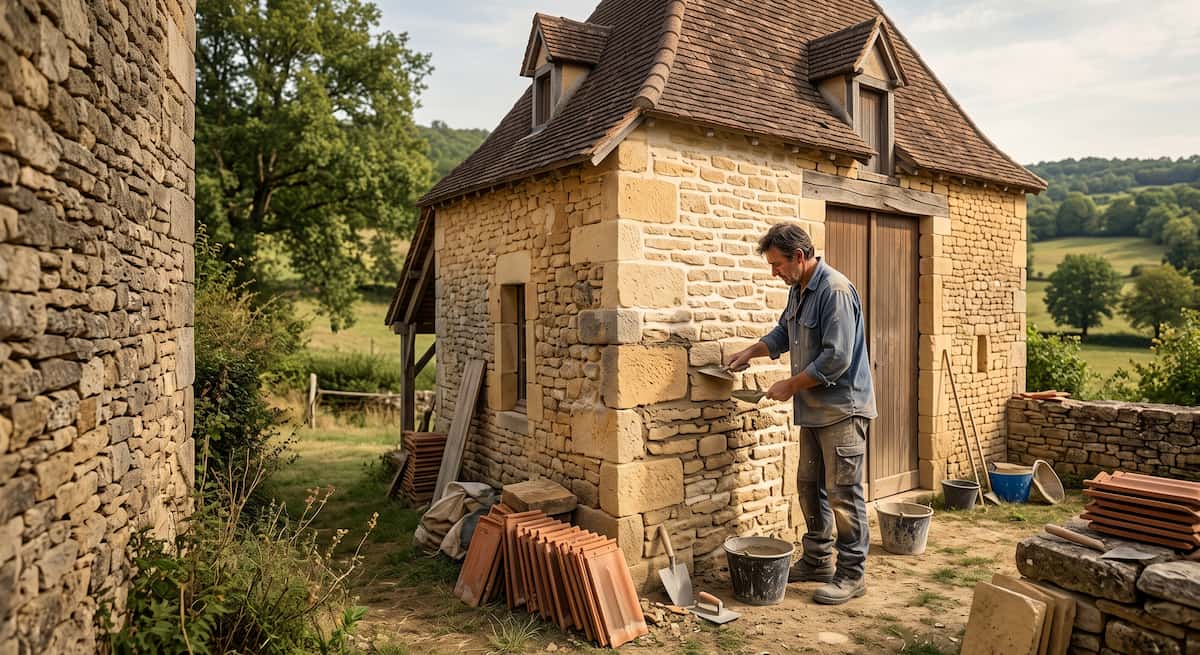
Renovating a traditional stone farmhouse in the Dordogne is very different from modernising a more recent house. Thick masonry walls, historic roof structures, lime-based finishes, moisture movement and local architectural traditions all need to be considered before work begins.
Whether you are restoring a Périgord farmhouse, a traditional longère or an old stone barn, the right materials and the right artisans can make the difference between a renovation that works with the building and one that creates expensive problems later.
This guide explains the main issues to consider, from lime mortar and roofing materials to insulation, heating, planning constraints and renovation costs.
The Architectural Character of Dordogne Properties
The Dordogne, particularly the Périgord Noir and Périgord Pourpre, is known for its traditional stone buildings constructed using locally available limestone and other regional materials.
You will find everything from substantial former farm buildings and corps de ferme to smaller stone houses, longères, barns and rural outbuildings.
The construction methods vary considerably between properties. Age, location, previous alterations and the materials originally used can all affect how a building should be repaired.
That is why a traditional stone property should not automatically be treated like a modern masonry house.
Before starting major work, it is worth understanding:
- how the walls were originally constructed;
- where moisture is entering and how it is leaving the building;
- whether previous cement repairs are causing problems;
- the condition of the roof and timber structure;
- how the floors and foundations interact with the ground;
- which parts of the building are historically significant;
- and whether planning or heritage controls apply to the property.
A good renovation starts with understanding the building before deciding how to alter it.
5 Important Principles for Renovating an Old Stone House
1. Manage Moisture Before Trying to Hide It
One of the most important principles when renovating traditional stone buildings is understanding moisture movement.
Older masonry buildings were often constructed using relatively permeable materials, including lime mortar, lime plaster and other mineral finishes. These materials can help moisture move through and evaporate from the building rather than concentrating it in one location.
That does not mean that cement should never be found on an old stone building, or that every cement repair automatically causes damp. The suitability of a material depends on the construction, location and condition of the building.
However, replacing large areas of traditional lime-based finishes with dense, less-permeable materials can alter the way moisture behaves within an old wall.
For this reason, a specialist should investigate the cause of damp before simply applying a waterproof coating or replacing traditional finishes.
Lime mortar and chaux
Traditional lime products may be appropriate for:
- repointing (rejointoiement);
- lime renders;
- internal lime plaster;
- some masonry repairs;
- and certain insulation systems.
The correct product matters. Natural hydraulic lime (chaux hydraulique naturelle, such as NHL 2 or NHL 3.5) is not interchangeable with every other lime product, and the appropriate formulation depends on the masonry and exposure.
France Rénov' also highlights the use of lime and hemp-based materials in appropriate older buildings because they can provide insulation while allowing effective moisture management.
The important rule is not simply "never use cement": Understand the existing wall before choosing the repair material. A builder experienced with traditional masonry should be able to explain why a particular mortar, render or insulation system is appropriate for the building.
2. Treat the Roof as a Major Structural System
The roof is often one of the largest potential expenses when renovating a traditional Dordogne property.
Before replacing roof coverings, have the entire roof structure assessed, including:
- roof timbers and connections;
- rafters and purlins;
- signs of woodworm or fungal decay;
- previous structural modifications;
- roof geometry and drainage;
- insulation;
- under-roof ventilation where appropriate;
- chimneys and flashing;
- and the condition of the existing covering.
Tiles, slate and lauzes
Traditional roofing varies across the Dordogne and neighbouring areas. Terracotta tiles are common across much of the region, while slate and lauzes are characteristic of some traditional buildings, particularly in areas where these materials formed part of the local architectural tradition.
Do not assume that replacing one material with another will be acceptable simply because both are used somewhere in the region.
Roof coverings can be subject to local planning and heritage requirements, particularly where the property is within a protected area.
If the existing roof is historically significant, retaining and repairing original materials may also be preferable to complete replacement where technically feasible.
3. Insulate the Building Without Creating Moisture Problems
Energy efficiency is an important part of renovating an old stone farmhouse, but insulation should not be considered separately from the building's moisture behaviour.
A traditional stone wall is not simply an under-insulated version of a modern cavity wall.
Before choosing insulation, consider:
- wall construction and thickness;
- existing damp;
- internal and external finishes;
- thermal bridges;
- ventilation;
- floor construction;
- roof insulation;
- window performance;
- and how the proposed system will interact with the existing masonry.
For some traditional buildings, vapour-permeable systems using materials such as wood fibre, hemp or lime-hemp may be appropriate. France Rénov' gives examples of older buildings successfully using lime-and-hemp systems as part of a broader renovation approach.
The best solution depends on the individual building rather than simply choosing the insulation with the highest advertised R-value.
4. Choose Heating Around the Building, Not Just the Heating System
Heating requirements can change significantly after insulation, window replacement and improvements to the building envelope.
For that reason, it is usually better to consider the whole building before choosing a new heating system.
Air-to-water heat pumps
An air-to-water heat pump can work well where the property has, or can accommodate, a suitable low-temperature distribution system such as underfloor heating or appropriately sized radiators.
However, installing a heat pump in an old farmhouse is not simply a matter of replacing a boiler with an outdoor unit. The installer should assess:
- heat loss;
- insulation;
- emitter capacity;
- hot-water requirements;
- electrical supply;
- outdoor-unit location;
- and the intended operating temperatures.
Wood and pellet heating
Wood-burning stoves, pellet stoves and biomass systems can also be suitable for rural properties, particularly where there is an appropriate fuel supply and the building layout allows effective heat distribution.
Again, the building and its ventilation requirements should be assessed before installation.
For renovation projects involving energy improvements, check current eligibility requirements for French renovation incentives rather than assuming that a particular heating system automatically qualifies for financial assistance.
5. Check Planning and Heritage Restrictions Before Changing the Exterior
Traditional properties in the Dordogne can be subject to planning and heritage controls that affect external alterations.
This can include changes to:
- roofs;
- windows and shutters;
- external render;
- stonework;
- extensions;
- solar panels;
- external insulation;
- and other changes affecting the appearance of the building.
What about the 500-metre ABF rule?
The commonly repeated statement that "any property within 500 metres of a historic monument automatically requires ABF approval" is too simplistic.
Where no specific périmètre délimité des abords exists, the protection can apply to buildings within 500 metres and in co-visibility with the historic monument.
Some monuments instead have a specifically defined périmètre délimité des abords (PDA) established under Ministère de la Culture heritage regulations, where the protection is based on the defined perimeter rather than simply applying the co-visibility test.
Work within protected areas can require prior authorisation and the involvement or agreement of the Architecte des Bâtiments de France (ABF).
The practical lesson is simple: Check the planning and heritage status of the property before ordering materials or starting external work. The local mairie or planning authority can help establish which rules apply to a particular property.
How Much Does It Cost to Renovate a Stone Farmhouse in Dordogne?
There is no reliable single renovation price per square metre for a traditional Dordogne farmhouse.
Two apparently similar stone properties can have dramatically different renovation costs depending on the condition of the roof, walls, foundations, floors, services and previous alterations.
As a broad 2026 planning guide, current French renovation benchmarks place:
| Level of renovation | Typical indicative range |
|---|---|
| Light refresh | €250 - €800 / m² |
| Partial/intermediate renovation | €700 - €1,500 / m² |
| Complete renovation | €1,000 - €2,000 / m² |
| Heavy structural restoration | €1,500 - €2,500+ / m² |
These are indicative figures rather than Dordogne-specific quotations. Current French renovation benchmarks show similarly wide ranges, with complete renovation commonly around €1,000 - €2,000 / m² and heavy renovation potentially considerably higher.
A traditional stone property can sit toward the upper end when it requires specialist masonry, roof reconstruction, structural repairs, bespoke joinery or extensive services replacement.
What can push the budget up?
Common cost drivers include:
- complete roof replacement;
- structural timber repairs;
- stone wall repairs;
- damp remediation;
- underpinning or foundation work;
- replacement of old electrical installations;
- new plumbing;
- drainage and sanitation;
- insulation;
- bespoke windows and doors;
- lime plaster and traditional finishes;
- kitchen and bathroom installation;
- heating systems;
- asbestos or lead-related work where applicable;
- access difficulties;
- and heritage requirements.
For an older property, it is sensible to maintain a contingency rather than spending the entire renovation budget on the initial quotation.
Which Artisans Do You Need?
A traditional farmhouse renovation can involve considerably more trades than a conventional house renovation. When planning comprehensive Building & Renovation projects in the region, coordinating the right specialists is essential.
Depending on the property, you may need:
Maçon / Mason
For structural masonry, stonework, foundations, openings, repointing and other building work. Look for a maçon with genuine experience of traditional stone construction rather than simply a general builder.
Couvreur / Roofing contractor
For roof repairs or replacement, including traditional tile, slate or lauze work where appropriate. Ask specifically about previous projects involving traditional roofs.
Charpentier / Carpenter
For structural timber, roof frames and repairs to traditional charpente.
Plombier / Heating engineer
For plumbing, hot water, heating systems and associated pipework.
Électricien / Electrician
For electrical replacement, upgrades and compliance work.
Artisan spécialisé en chaux
For specialist lime pointing, renders and plaster where the building requires traditional or compatible materials. Not every general builder will have the same level of experience with lime-based construction.
How to Choose an Artisan for a Dordogne Renovation
Price should not be the only consideration when comparing contractors.
For a traditional property, ask potential artisans:
- Have you renovated traditional stone properties before?
- Can you show me examples of comparable projects?
- What do you think is causing the damp?
- Which mortar or render do you propose and why?
- What work will be carried out by subcontractors?
- What is included and excluded from the quotation?
- What insurance cover applies to the work?
- Can you provide your current attestation d'assurance?
- Is your SIRET number active and consistent with the business details?
- Do the proposed external changes require planning permission or heritage approval?
For significant structural or building work, verify the contractor's Décennale insurance before work begins and check that the insured activities correspond to the work being undertaken. Our comprehensive Garantie Décennale insurance guide details how to read an attestation and avoid invalid certificates.
A SIRET check is also useful, but remember that a valid SIRET does not by itself prove insurance, competence or the quality of previous work. Read our step-by-step guide on how to check a French artisan's SIRET to verify legal status and active trade codes.
Get the Right Survey Before You Get the Quote
One of the most expensive mistakes in an old farmhouse renovation is obtaining a detailed quote before properly understanding the building.
Before committing to major work, consider whether you need an assessment of:
- structural condition;
- roof and timber condition;
- damp and moisture movement;
- drainage;
- electrical installation;
- plumbing;
- insulation and energy performance;
- sanitation;
- hazardous materials where relevant;
- and planning or heritage restrictions.
A €1,500 repair discovered during an inspection can be very different from a €15,000 structural problem discovered after the walls or roof have already been opened.
Renovating Old Stone Buildings the Right Way
A successful Dordogne farmhouse renovation is not simply about making an old building look new.
The best projects understand how the original building works and then improve it without creating new problems.
That means investigating moisture before covering walls, assessing the roof before replacing tiles, selecting insulation around the characteristics of the building, checking planning restrictions before altering the exterior and choosing artisans who understand traditional construction.
If you are looking for builders, roofers, masons, heating engineers or other renovation specialists in the Dordogne, VeriLocal helps homeowners find local businesses and compare suitable professionals based on location, services, language and verification information.
Tell us what you need. We will find suitable local businesses.
Do not risk hiring unverified contractors. Describe your project once and receive matched introductions to up to 3 verified local businesses with checked SIRET registrations and active Décennale insurance.


