
How to Check a French Tradesperson Before You Hire Them
Finding a tradesperson in France is only the first step. Before you agree to work, pay a deposit or hand over the keys to your property, it is important to carry out some basic checks.
This is particularly important if you own a property in France but live abroad. You may be relying on photographs, emails, WhatsApp messages and video calls rather than being able to visit the property regularly. A tradesperson who speaks English can make communication much easier, but English-speaking ability should not be confused with professional verification.
Before hiring a French tradesperson, you should ideally check their business identity, SIRET number, relevant insurance, experience, references and devis. For building and renovation work, you should also understand whether the work falls within the scope of the professional's décennale insurance.
This guide explains how to check a French tradesperson before you hire them, what documents to ask for, what warning signs to look for and how to make a more informed decision.
Looking for a tradesperson first? Read our guide to How to Find and Hire English-Speaking Tradespeople in France
Why Should You Check a French Tradesperson Before Hiring Them?
Finding someone who can do the job is not the same as establishing whether they are the right professional for your project.
A recommendation from a neighbour, Facebook group or property owner can be useful, but it should be treated as a starting point rather than proof of suitability.
Before hiring a tradesperson, you want to establish several things:
- Who is the business?
- Is the business properly registered?
- Does the SIRET information correspond to the person or company you are dealing with?
- Does the professional have the appropriate insurance?
- Does their insurance cover the type of work you are asking them to perform?
- Do they have relevant experience?
- Can they provide examples or references for similar work?
- Is the devis sufficiently detailed?
- Are the price, materials, labour and timescales clear?
- Who will actually carry out the work?
- How will additional work be agreed?
- How will you communicate if you are not living locally?
None of these checks guarantees that a project will go perfectly.
However, together they can significantly reduce the risk of choosing a professional who is unsuitable for the work.
1. Check the Tradesperson's Business Identity
One of the simplest checks is to establish exactly who you are contracting with.
Ask the tradesperson for their:
- Full business name
- Business address
- SIRET number
- SIREN number, where relevant
- Contact details
- Legal business status
- Details of the person responsible for the business
The information should be consistent across their quotation, invoices, website, insurance documents and other business correspondence.
This is particularly important when a tradesperson operates under a trading name that is different from the legal name of the business.
What is a SIRET number?
The SIRET is a French business identification number. It identifies an individual establishment of a business.
It is useful when checking that you are dealing with a real registered business, but a SIRET number is not a guarantee of workmanship, reliability or insurance.
That distinction is important.
A business can be correctly registered and still be unsuitable for your particular project.
For a more detailed explanation, see our guide:
How to Check a French Artisan SIRET
Use the SIRET check as one part of your due diligence rather than treating it as a complete verification process.
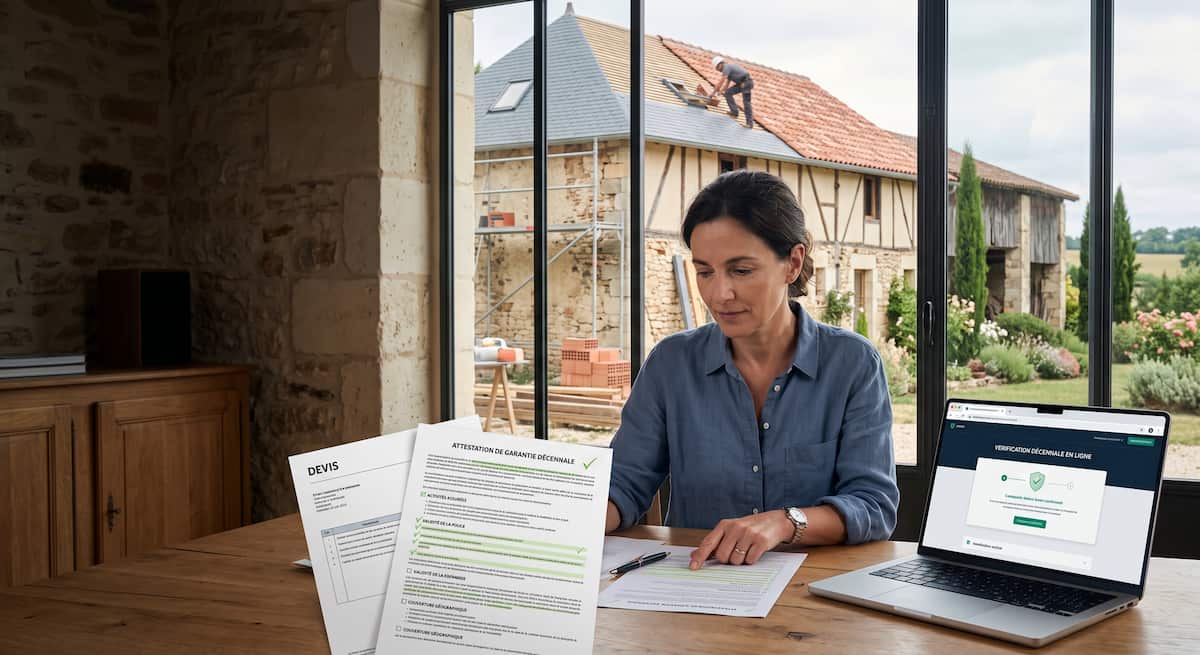
2. Check Their Insurance Before Work Starts
For many property owners, insurance is one of the most important checks when hiring a French tradesperson.
Building professionals can be subject to mandatory professional insurance requirements, including responsabilité civile professionnelle (RCP) and responsabilité décennale for work falling within the scope of the décennale regime. French government guidance states that professionals in the building sector must be able to justify the required insurance at the start of the relevant work.
What is décennale insurance?
The French garantie décennale is a form of construction liability protection relating to certain defects and damage affecting the structure or making the building unsuitable for its intended purpose.
The responsibility can extend for ten years from the reception of the works.
That does not mean every piece of work carried out by every tradesperson is automatically covered by décennale.
The nature of the work matters.
For example, major structural, roofing or other building work can raise very different insurance considerations from simple decorative work or routine maintenance.
Ask to see the insurance certificate
Don't simply ask:
"Are you insured?"
Ask for documentary evidence.
Depending on the work, you may need to check:
- Name of the insured business
- Insurer
- Policy number
- Policy period
- Activities covered
- Geographical coverage
- Relevant construction activities
- Whether the certificate relates to the business carrying out your work
For some building trades, the insurance attestation is required to accompany quotations or invoices when the décennale insurance is mandatory.
You can learn more in our dedicated guide:
Garantie Décennale Insurance in France: What Property Owners Need to Know
Don't assume "decennial insurance" covers everything
This is an important distinction.
A tradesperson might have décennale insurance but that does not necessarily mean the policy covers every type of work they offer.
If you are asking a business to carry out several different types of work, check that the relevant activities are included.
For example, don't assume that a general contractor's insurance automatically covers specialist work simply because the business says it can provide that service.
If you are uncertain, ask the professional to explain exactly what their insurance covers.
3. Make Sure the Insurance Matches the Work
For a renovation project, this can be more important than simply establishing that an insurance certificate exists.
Imagine you are renovating an old stone property and need:
- Structural masonry
- Roof repairs
- Insulation
- Electrical work
- Plumbing
- Drainage
- Window installation
Different trades may involve different qualifications, responsibilities and insurance considerations.
Before accepting a quotation, compare the proposed work with the activities described on the insurance documentation.
You should be particularly cautious if:
- The professional refuses to provide an insurance certificate.
- The certificate has expired.
- The name on the certificate does not match the business you are hiring.
- The activity described does not appear to correspond with the proposed work.
- The policy dates do not cover the planned work.
- The professional says insurance is unnecessary without explaining why.
- You are asked to begin work before the documentation is provided.
For significant renovation projects, obtaining appropriate professional advice before work begins can be worthwhile.
4. Check Their Experience With Your Type of Property
A tradesperson can be perfectly competent but still not be the best choice for your particular property.
This is particularly relevant in Southwest France, where property owners may be dealing with:
- Traditional stone houses
- Former farm buildings
- Barn conversions
- Rural properties
- Gîtes
- Old village houses
- Properties with thick masonry walls
- Properties with unusual roofs or construction methods
- Buildings requiring sympathetic renovation
Ask whether the tradesperson has worked on similar properties.
Instead of simply asking:
"Are you experienced?"
ask more specific questions:
- Have you worked on similar properties?
- Have you renovated old stone buildings?
- Can you show me examples of comparable work?
- How do you normally deal with old masonry?
- Have you worked on properties in this area?
- Are you familiar with the materials and construction methods involved?
Relevant experience is often much more useful than a generic claim of being experienced.
5. Ask for References or Examples of Previous Work
References can provide useful additional information, although they should not be treated as absolute proof.
Ask for examples of completed projects that are similar to yours.
Where appropriate, ask:
- When was the work completed?
- What type of work was carried out?
- Was the project completed on time?
- Did the final cost remain close to the original quotation?
- How were changes handled?
- Was communication good?
- Would the previous client use the tradesperson again?
If the tradesperson is unable to provide any examples, that does not automatically mean there is a problem.
A newly established business, for example, may have relevant experience gained while working for another company.
The important thing is to understand who you are hiring and what evidence there is to support their suitability.
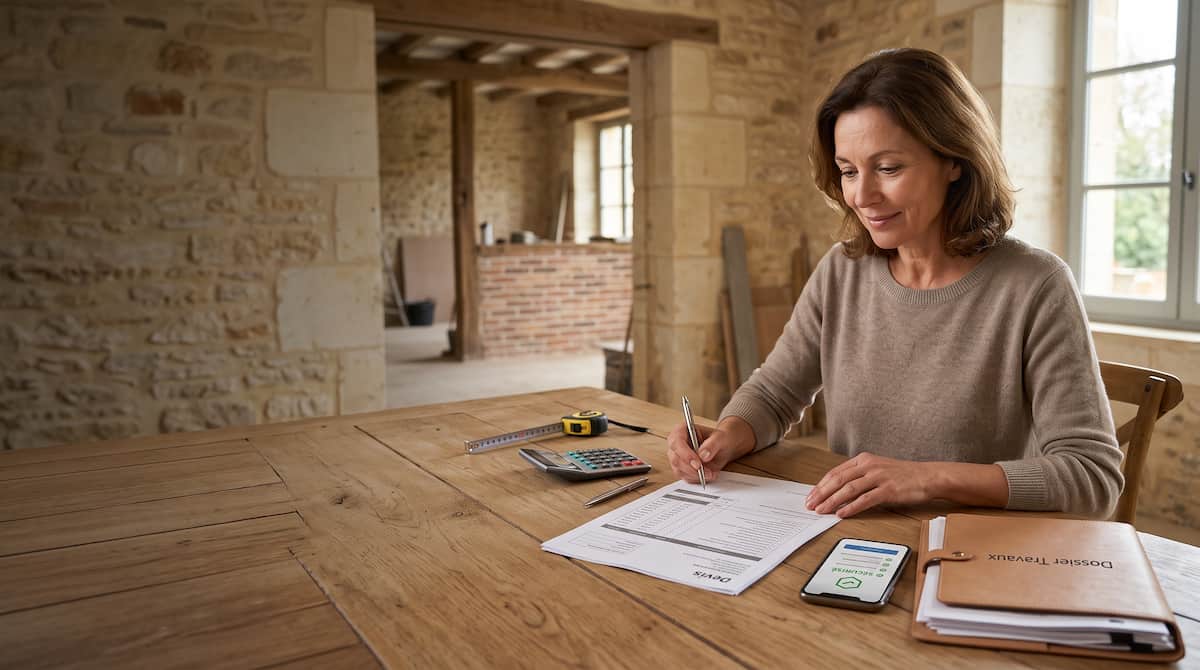
6. Get a Detailed Devis
One of the most important documents in a French renovation project is the devis.
A devis is more than a rough price estimate. For relevant services, French consumer guidance requires detailed information, and once accepted, a devis can become contractually binding.
For building and home-equipment work, a devis may include information such as:
- Date
- Business name and address
- Client details
- Location of the work
- Description of the work
- Individual quantities
- Unit prices
- Labour costs
- Materials
- Travel costs where applicable
- VAT rate
- Total HT
- Total TTC
- Validity period
- Expected start date or duration where applicable
A good devis should allow you to understand what you are actually paying for.
Avoid vague quotations
Be cautious about quotations that simply say:
"Renovation works — €25,000"
That tells you very little.
A more useful devis should explain what is included.
For example:
- Remove existing roof covering
- Supply and install specified roofing material
- Replace damaged timber
- Install insulation
- Labour
- Waste removal
- Scaffolding
- VAT
The more complex the project, the more important this becomes.
For a fuller explanation, see:
Understanding French Devis for Renovation Projects
7. Understand What Is Not Included
One of the biggest sources of disputes in renovation projects is not necessarily the original price.
It is the difference between what the client thought was included and what the tradesperson thought was included.
Before accepting a devis, ask:
- Is waste removal included?
- Is scaffolding included?
- Are materials included?
- Is delivery included?
- Are preparation works included?
- Is making good included?
- Is painting included?
- Are permits or inspections included?
- Who pays for specialist surveys?
- What happens if unexpected damage is discovered?
This is particularly important with older French properties.
A tradesperson opening up a wall or roof may discover problems that could not reasonably have been seen beforehand.
The important thing is to establish how unexpected work will be handled.
8. Agree How Additional Work Will Be Approved
If you live outside France, this is one of the most important practical questions to resolve before the project begins.
Suppose your builder discovers rotten timber behind a wall.
They say an additional €2,000 of work is required.
How will you approve it?
You should establish in advance:
- Who contacts you?
- Will additional work require written approval?
- Will you receive a revised devis?
- Can work proceed without your approval?
- What happens in an emergency?
- How quickly can you be expected to respond?
For remote property owners, having a clear process can prevent small unexpected issues from becoming major disagreements.
A simple written agreement such as:
"Additional work above €500 requires written approval before proceeding"
can make expectations much clearer.
The precise contractual arrangement should, of course, reflect the project and the advice of an appropriate professional.
9. Check Who Will Actually Carry Out the Work
When you hire a company, make sure you understand whether the work will be performed by:
- The business owner
- Employees
- Independent tradespeople
- Subcontractors
- Several different companies
This matters because the contractual relationship and insurance arrangements can differ.
If subcontractors are involved, ask:
- Who is responsible for their work?
- Who contracts with them?
- Are they appropriately insured?
- Will their details be provided?
- Who should you contact if something goes wrong?
Do not assume that because the main contractor has insurance, every subcontractor's work is automatically covered in the same way.
For substantial projects, this is an area where professional advice can be valuable.
10. Check Their Communication - But Don't Stop There
If you are an English-speaking property owner, finding a tradesperson who speaks English can be extremely helpful.
It can make it easier to:
- Explain your requirements
- Discuss changes
- Understand technical terminology
- Review a devis
- Discuss problems
- Arrange access
- Manage a project remotely
But English-speaking does not mean verified.
A tradesperson should not be chosen solely because they can communicate in English.
Ideally, you want the combination of:
Good communication + relevant experience + proper registration + appropriate insurance + clear documentation + reliable project management.
That is a much stronger basis for making a decision.
If you have not yet found a suitable professional, see:
How to Find and Hire English-Speaking Tradespeople in France
11. Watch for Red Flags
No single warning sign necessarily proves that a tradesperson is unreliable.
However, several warning signs together should make you stop and investigate further.
Be cautious if a tradesperson:
- Refuses to provide a SIRET number.
- Gives inconsistent business information.
- Refuses to provide insurance documentation.
- Provides an insurance certificate that does not appear to match the business.
- Cannot explain what their insurance covers.
- Wants substantial payment before providing documentation.
- Pressures you to accept a quotation immediately.
- Provides an extremely vague devis.
- Refuses to put important agreements in writing.
- Changes the price repeatedly without explanation.
- Wants payment into an unrelated personal or third-party account.
- Cannot explain who will actually carry out the work.
- Discourages you from seeking other quotations.
- Says that formal paperwork is unnecessary.
- Is unwilling to discuss how unexpected work will be approved.
None of these automatically proves misconduct.
But they are reasons to slow down rather than rush into an agreement.
12. Be Careful With Deposits and Payments
Before making a payment, establish exactly what it relates to.
Your devis or contract should make the payment arrangements clear.
Ask:
- How much is required initially?
- When are further payments due?
- What does each payment relate to?
- Is the payment an advance, deposit or other agreed amount?
- What happens if the project is delayed?
- How are variations handled?
- What documentation will you receive?
Avoid making large payments simply because a tradesperson says:
"I need the money today to secure the materials."
There may be legitimate reasons for advance payments, particularly for bespoke materials or large orders, but you should understand what you are paying for and have the arrangement documented.
13. Check the Devis Against the Insurance
This is a useful final cross-check that many property owners overlook.
Once you have the devis and insurance documentation, compare them.
For example, if the devis includes:
Roof structure repairs
but the insurance documentation appears to cover only a different category of work, ask the tradesperson to clarify the situation before signing.
Likewise, if the project has several components, don't assume that one insurance certificate automatically answers every question.
You are not expected to become an insurance expert.
The purpose of the check is simply to identify obvious inconsistencies and ask questions before the work begins.
14. If You Are Managing the Project From Abroad
Checking the tradesperson is only part of the process.
If you are living in the UK, Ireland, the Netherlands, Belgium or elsewhere while your property is in France, think about how the project will actually be managed.
Agree:
- Primary contact
- Preferred communication method
- How often you receive updates
- Whether photographs will be provided
- Who has access to the property
- Where keys are held
- How unexpected problems are reported
- How additional work is approved
- How progress payments are documented
- Who coordinates different trades
A reliable communication process can make a major difference to an overseas renovation.
For larger projects, you may also want to consider whether you need a local project manager, maître d'œuvre or other professional to coordinate the work.
15. Don't Rely on a Single Recommendation
Personal recommendations can be extremely valuable in France.
Your neighbour may know an excellent plumber.
Another expat may recommend a builder.
A local mairie may be able to point you towards businesses operating in the area.
These recommendations are worth investigating.
But you should still carry out your own checks.
A tradesperson who was excellent for a €1,000 plumbing repair may not necessarily be the right choice for a €100,000 structural renovation.
Match the professional to the scale, complexity and nature of the work.
A Practical Checklist Before Hiring a French Tradesperson
Before you accept a quotation, work through this checklist.
Business
- Business name checked
- Address confirmed
- SIRET checked
- Business details consistent across documents
- Person responsible for the business identified
Insurance
- Appropriate insurance certificate requested
- Insurer identified
- Policy dates checked
- Activities covered checked
- Insurance appears relevant to the proposed work
- Any questions about coverage clarified
Experience
- Relevant experience discussed
- Similar projects identified
- Previous work reviewed where possible
- References considered
Quotation
- Detailed devis received
- Labour identified
- Materials identified
- VAT understood
- Timescales discussed
- Payment schedule understood
- Additional work process agreed
- Exclusions identified
Project management
- Main contact identified
- Communication method agreed
- Property access arranged
- Progress updates agreed
- Additional work approval process established
If several of these boxes remain unchecked, it may be worth resolving them before proceeding.
How VeriLocal Can Help You Find a French Tradesperson
Finding the right professional can be particularly difficult when you are not living locally.
You may be searching in English, while the businesses you need are operating primarily in French.
You may also want to find someone who:
- Works in your area
- Provides the specific service you need
- Can communicate in English
- Understands the requirements of international property owners
- Has relevant business information available
- Can be assessed against practical verification criteria
That's where VeriLocal is designed to help.
Instead of simply choosing a business because it appears high in a directory, you can search for the type of professional you need and consider relevant information about the business, location, services and verification.
Explore French tradespeople and local businesses on VeriLocal
You can also tell VeriLocal what you need and use your project requirements to help identify suitable businesses.
Verification is not a guarantee that a project will be completed perfectly. You should still review the professional's documentation, quotation and suitability for your particular project.
The aim is to make the initial search and comparison process easier and more transparent.
Finding a Tradesperson Is Only the Beginning
For international property owners, the hardest part of hiring a tradesperson in France is often not finding someone who can do the work.
It is knowing whether the person you have found is appropriate for the job.
A professional website, an English-speaking employee or a recommendation from another property owner can all be useful.
But before committing to significant work, take a little time to check the fundamentals:
Who are they?
Are they properly registered?
Are they appropriately insured?
Does their insurance correspond to the work?
Do they have relevant experience?
Is the devis detailed enough?
Are payment arrangements clear?
Do you know how additional work will be handled?
These checks become even more important when you are managing a French property from abroad.
You don't need to become an expert in French construction law before hiring a plumber, roofer, electrician or builder.
You do, however, need enough information to make an informed decision.
Useful Official Resources
For authoritative information about French building and consumer requirements, consult official French government sources.
- French Ministry of Economy — Devis obligatoire: explains when a quotation is mandatory and what information it should contain.
- DGCCRF — Devis: explains the role of a devis and when it becomes contractually binding.
- Service-Public.fr — Garantie décennale des constructeurs: provides official information about décennale insurance and related legal requirements.
- French Ministry of Economy — Professional insurance requirements: provides information about compulsory insurance for various professions, including building professionals.
Final Thought
Hiring a tradesperson in France doesn't have to be complicated, but it is worth slowing down before you commit.
Check the business. Check the SIRET. Check the insurance. Check the experience. Check the devis. Then make your decision.
For international property owners, those few extra checks can make the difference between simply finding someone who says they can do the job and finding a professional who appears genuinely suitable for the work you need.
Find verified local businesses and tradespeople on VeriLocal
This guide provides general information for property owners and is not a substitute for legal, insurance or professional advice relating to a specific project. Requirements can vary according to the nature of the work and the professional's legal status.
Planning a job? Get a rough idea of the cost
Before comparing quotations, it can help to understand the likely cost of the work. GoTaskhub's free Job Pricing Estimator gives tradespeople an indicative starting point based on the type and scope of the job.
Tell us what you need. We will find suitable local businesses.
Do not risk hiring unverified contractors. Describe your project once and receive matched introductions to up to 3 verified local businesses with checked SIRET registrations and active Décennale insurance.