
How to Avoid Renovation Scams and Bad Contractors in France
Renovating a property in France can be exciting, but it can also be stressful - particularly if you are an international property owner managing the project from another country.
Whether you are repairing an old stone farmhouse, renovating a gîte, replacing a roof or carrying out a larger restoration project, choosing the wrong contractor can lead to delays, unexpected costs, poor workmanship and difficult disputes.
The good news is that many problems can be identified before work begins.
You do not need to assume that every French artisan is risky, nor should you be suspicious simply because a business is small or works independently. Most professionals are legitimate businesses.
The key is to carry out sensible checks before committing to substantial work.
This guide explains how to avoid renovation scams and bad contractors in France, including what to check, which warning signs to take seriously and how to protect yourself when managing renovation work remotely.
For a broader introduction to finding English-speaking tradespeople in Southwest France, see our guide to Finding English-Speaking Artisans in Southwest France.
Are Renovation Scams Common in France?
Renovation fraud is a recognised consumer-protection issue in France, particularly in areas such as energy renovation.
French authorities have investigated businesses using misleading sales practices, unclear contracts, false claims about qualifications or government schemes, aggressive sales techniques and other deceptive practices.
The French consumer-protection authority, the DGCCRF, has specifically warned about practices including misleading advertising, false RGE claims, unclear contracts, fake references and pressure to sign renovation agreements quickly.
That does not mean that renovation contractors in France should generally be regarded with suspicion.
Instead, it means that homeowners should use a sensible due-diligence process before agreeing to significant work.
The same principle applies whether you are dealing with a large construction company, a small artisan or an independent tradesperson.
1. Don't Choose a Contractor Solely Because They Were Recommended
A personal recommendation can be extremely useful.
If a neighbour, friend or another property owner has had a positive experience with an artisan, that is valuable information.
But a recommendation should be a starting point rather than the only check you make.
A contractor who did an excellent job repairing one person's bathroom may not necessarily have the experience, insurance or availability required for your roof, structural renovation or traditional stone property.
Before hiring a recommended contractor, still check:
- Their business identity
- Their SIRET number
- Their relevant insurance
- Their experience with the proposed work
- Their references
- Their quotation
- Who will actually carry out the work
This is particularly important when the person making the recommendation has never used the contractor for a project similar to yours.
If you want a detailed checklist, see our guide to How to Check a French Tradesperson Before You Hire Them.
2. Check the Business and SIRET Information
One of the simplest checks is to establish exactly who you are dealing with.
A legitimate French business should have identifiable business information, including its legal name and SIRET number where applicable.
The SIRET identifies a particular establishment of a business.
However, it is important to understand what a SIRET check does - and does not - tell you.
A SIRET check can help establish that you are dealing with an identifiable registered business.
It does not prove:
- That the contractor is reliable
- That their workmanship is good
- That they have appropriate insurance
- That they have experience with your particular project
- That their quotation is reasonable
- That they will complete the work on time
In other words, registration is a basic check, not a guarantee.
For a step-by-step explanation, see our guide to How to Check a French Artisan's SIRET Number.
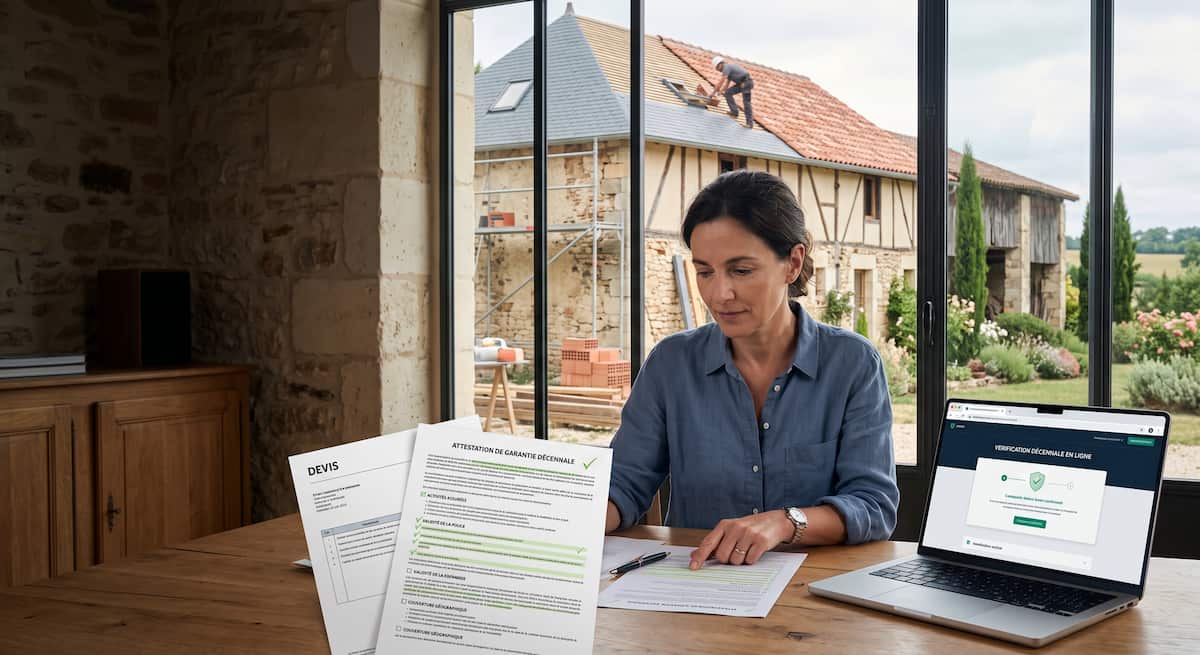
3. Check the Contractor's Insurance
For relevant construction work, insurance is one of the most important checks you can make.
Depending on the work involved, a contractor may need appropriate professional insurance, including Garantie Décennale coverage.
The décennale system is particularly important because it can cover certain serious construction defects affecting the structure or making the building unsuitable for its intended use.
French rules require relevant professionals to have appropriate insurance, and the insurance information should be documented appropriately.
Do not simply ask:
"Are you insured?"
Ask for the actual documentation.
Check:
- The name of the insured business
- The insurer
- The policy number
- The policy period
- The geographical coverage
- The activities covered
- Whether the proposed work falls within the insured activities
This last point is particularly important.
A contractor having décennale insurance does not automatically mean that every type of work they undertake is covered.
For more information, see our guide to Garantie Décennale Insurance in France.
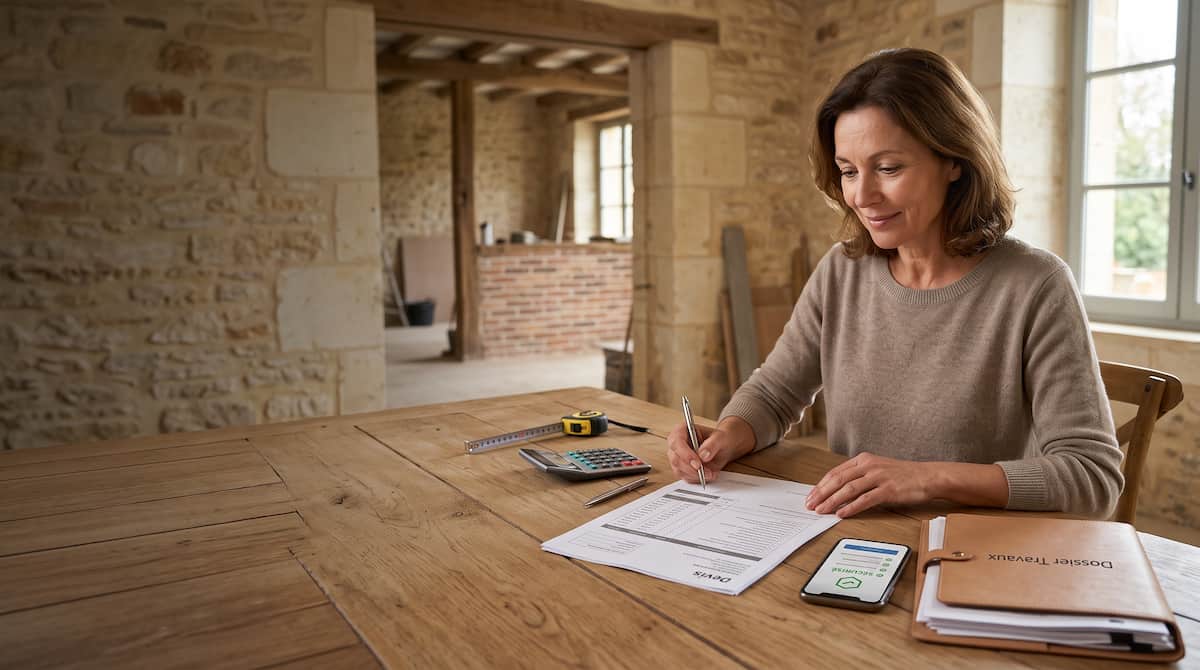
4. Be Wary of Vague or Incomplete Devis
A vague quotation makes it difficult to know what you are actually buying.
For example:
"Renovation works - €35,000"
tells you very little.
A detailed devis should give you a much clearer understanding of the proposed work, costs and relevant conditions.
The DGCCRF explains that a devis is an offer of contract and, once accepted, can become binding on the parties.
Depending on the work and circumstances, a detailed quotation may include information such as:
- The contractor's business details
- The client's details
- The address where the work will take place
- A description of the work
- Quantities
- Unit prices
- Labour costs
- Materials
- Travel or other charges
- VAT
- Total price
- Validity period
- Timing or duration
- Relevant insurance information
If you cannot understand what is included in a quotation, do not feel pressured to accept it simply because the contractor tells you that everything is "standard".
Take the time to ask questions.
Our guide to Understanding French Devis Renovation Quotes explains what to look for when reviewing a French renovation quotation.
5. Don't Automatically Choose the Cheapest Quote
Price is important, but the cheapest quote is not necessarily the best value.
If three contractors quote approximately €20,000, €22,000 and €21,500, but another contractor quotes €11,000, you need to understand why.
The cheaper quotation might exclude:
- Materials
- Scaffolding
- Waste removal
- Preparation work
- Finishing
- Electrical work
- Plumbing
- VAT
- Site protection
- Additional labour
Alternatively, the contractor may simply have a different approach.
The important thing is to compare like with like.
Ask each contractor to explain significant differences in price.
French government guidance on renovation fraud also recommends comparing offers and taking time to examine the proposed work and documentation before signing.
A very low price should not automatically be treated as a bargain.
Sometimes it is a warning that something important has been left out.
6. Never Let Pressure Make the Decision for You
One of the clearest warning signs is pressure to commit immediately.
Be cautious if a contractor tells you:
- "You need to sign today."
- "This price is only available for the next hour."
- "We have another customer waiting."
- "The price will double if you don't accept now."
- "You don't need to compare other quotes."
- "Just pay the deposit and we will sort the paperwork later."
Legitimate contractors can have busy schedules and may have quotation validity periods.
That is different from deliberately creating pressure to prevent you from checking the business or comparing alternatives.
French authorities have specifically warned consumers about aggressive sales practices in the renovation sector and advise homeowners not to rush into signing contracts.
If you feel pressured, step back.
A contractor who becomes difficult simply because you want time to check their documentation is giving you useful information.
7. Be Especially Careful With Unsolicited Renovation Offers
Unexpected approaches deserve additional caution.
This can include someone who:
- Knocks on your door offering to inspect the roof
- Claims to have noticed urgent damage
- Says they are working for the local authority
- Claims that new regulations require immediate work
- Offers a free inspection followed by an expensive quotation
- Says they are carrying out checks for a government programme
- Contacts you unexpectedly about energy renovation
This does not mean every unsolicited approach is fraudulent.
However, French authorities have documented cases where consumers were told that urgent or mandatory works were required when that was not actually the case.
If someone tells you that work is legally required, do not simply take their word for it.
Ask for the legal basis and obtain independent confirmation.
8. Be Careful With Energy-Renovation Promises
Energy renovation deserves particular caution.
This includes projects involving:
- Insulation
- Heat pumps
- Solar panels
- Heating systems
- Windows
- Roof insulation
- Energy-efficiency improvements
The French government and DGCCRF have repeatedly warned about fraudulent or misleading practices in this sector, including fake claims about government support, misleading RGE references, unclear contracts and false information about eligibility for financial assistance.
If a contractor tells you:
"The government will pay for most of this."
or:
"You are entitled to this grant because I have checked your property."
verify the claim independently before signing anything.
Do not treat a promise of financial assistance as proof that the company is trustworthy.
For energy-renovation projects, check official information and, where relevant, verify RGE status independently rather than relying solely on the contractor's website or sales material.
9. Check Who Will Actually Do the Work
You may think you are hiring one company but discover that several other businesses or subcontractors will actually be working on the property.
Subcontracting is not automatically a problem.
Many legitimate construction businesses use subcontractors or specialist trades.
The important question is whether the arrangement is clear.
Ask:
- Who will carry out the work?
- Will subcontractors be used?
- Which parts of the project will they undertake?
- Who is responsible for their work?
- Are the relevant insurance arrangements in place?
- Who should you contact if something goes wrong?
This becomes particularly important for international property owners who may not be present on site.
Recent French government guidance on renovation fraud specifically highlights the importance of transparency around subcontracting in energy-renovation work.
10. Be Careful With Large Upfront Payments
A deposit or acompte is not automatically a sign of a scam.
Construction projects often involve upfront costs for materials, labour and scheduling.
The issue is whether the payment arrangement is reasonable and clearly documented.
Before making a substantial payment, establish:
- What the payment is for
- Whether it is an acompte or another form of deposit
- What work it relates to
- When work will begin
- What happens if the project is cancelled
- What payment stages will follow
- Whether payments correspond to agreed milestones
Be particularly cautious if someone demands a very large payment immediately while refusing to provide proper documentation.
Also check that you are paying the correct business entity.
If the quotation is from one company but you are suddenly asked to transfer money to an unrelated personal bank account, stop and ask questions.
11. Don't Agree to Major Changes Verbally
Renovation projects rarely go exactly according to plan.
Once walls are opened, floors removed or roofs stripped, unexpected problems can appear.
You may discover:
- Rotten timber
- Hidden leaks
- Structural damage
- Old wiring
- Poor previous repairs
- Damp
- Damaged masonry
- Unexpected drainage problems
Additional work may genuinely be necessary.
The problem occurs when substantial additional costs are agreed informally and then become difficult to dispute.
If the scope or price changes significantly, ask for the change to be documented.
Ideally, establish:
- What has been discovered
- What additional work is required
- Why it is necessary
- The additional cost
- Any effect on the completion date
This is particularly important when you are managing the property from abroad.
12. Check References - But Don't Rely on Reviews Alone
Online reviews can be useful, but they should not be your only source of information.
A business can have excellent reviews and still not be suitable for your project.
Look for evidence that the contractor has completed work similar to yours.
Ask for:
- Examples of previous projects
- Photographs of completed work
- References where appropriate
- Experience with similar properties
- Experience with the materials or techniques required
For example, renovating an old stone farmhouse may require very different knowledge from working on a modern apartment.
A contractor experienced in new-build construction may not necessarily understand traditional masonry, lime work or older roof structures.
13. Watch for These Contractor Red Flags
No single warning sign proves that a contractor is fraudulent.
However, several warning signs appearing together should make you reconsider.
Red flags include:
- No identifiable business information
- Refusal to provide a SIRET
- Insurance documentation cannot be provided
- Insurance does not appear to cover the proposed work
- Vague or handwritten quotations with little detail
- Pressure to sign immediately
- Pressure to make a large payment upfront
- Claims that work is legally mandatory without evidence
- Unexplained changes to the price
- Refusal to put important agreements in writing
- Unclear subcontracting arrangements
- Bank details that do not match the contracting business
- Reluctance to provide references
- Claims about government grants that cannot be independently verified
- A website containing impressive claims but little verifiable business information
- Attempts to discourage you from obtaining other quotations
The key is to look at the overall pattern.
One unusual detail may have an innocent explanation.
Several unexplained warning signs should make you pause.
14. Be Extra Careful When Managing Renovation Work From Abroad
International property owners face an additional risk: distance.
If you live in the UK, Belgium, the Netherlands or elsewhere outside France, you may not be able to visit the property every week.
That makes good documentation even more important.
Before work begins, agree:
- How often you will receive updates
- Who will send photographs
- How additional work will be approved
- Who has keys
- Who can authorise contractors to enter the property
- How invoices will be delivered
- How payments will be approved
- Who coordinates different trades
- What happens if you cannot be contacted immediately
A simple written process can prevent major misunderstandings.
For example:
No additional work above €500 without written approval.
The precise amount will depend on your project, but the principle is useful: agree the process before there is a problem.
15. Get More Than One Quote for Significant Work
For substantial renovation work, obtaining multiple quotations can help you understand whether the proposed price and scope are realistic.
You do not necessarily need five or six contractors.
Two or three well-chosen quotations may be more useful than a large collection of vague estimates.
When comparing them, look beyond the final price.
Compare:
- Scope of work
- Materials
- Labour
- VAT
- Timescale
- Payment schedule
- Insurance
- Guarantees
- Exclusions
- Additional work arrangements
A contractor who is slightly more expensive may actually be offering a much more comprehensive specification.
How to Check a French Contractor Before Hiring Them
Before committing to significant renovation work, use a simple verification process.
Business
☐ Confirm the business name
☐ Check the SIRET
☐ Check that the information is consistent
Insurance
☐ Request relevant insurance documentation
☐ Check the insured business name
☐ Check policy dates
☐ Check the activities covered
☐ Confirm the insurance is relevant to the work
Experience
☐ Ask about similar projects
☐ Request examples of previous work
☐ Check references where appropriate
Quotation
☐ Request a detailed devis
☐ Check what is included
☐ Check what is excluded
☐ Check VAT
☐ Check payment terms
☐ Check timing
☐ Understand how additional work will be approved
Contractor
☐ Establish who will actually carry out the work
☐ Ask whether subcontractors will be used
☐ Establish who is responsible for coordination
Payment
☐ Understand deposits and payment stages
☐ Make sure payment details correspond to the contracting business
☐ Avoid unexplained or unusual payment requests
Communication
☐ Agree how progress will be reported
☐ Agree how urgent problems will be handled
☐ Keep important decisions in writing
What If You Think You've Already Been Scammed?
If you believe something has gone wrong, do not simply ignore it and hope that the situation resolves itself.
Keep copies of:
- The original devis
- Contracts
- Invoices
- Bank transfers
- Emails
- Messages
- Photographs
- Insurance documents
- Business details
- Any correspondence about additional work
If there is a dispute about defective work, obtain appropriate professional advice before undertaking major remedial work where possible.
French consumer-protection guidance explains that different construction guarantees can apply to defective work, including the guarantee of perfect completion, the two-year guarantee and the ten-year guarantee for qualifying defects.
Depending on the circumstances, you may also need to contact the relevant insurer, consumer mediator, legal professional or consumer-protection service.
Do not rely on informal promises if a significant financial dispute has already developed.
How VeriLocal Can Help
Avoiding bad contractors starts with having better information before you make contact.
VeriLocal is designed to help homeowners in Southwest France find businesses based on their location, services and communication requirements, while providing useful business information and verification details.
You can describe what you need in English or French and search for businesses relevant to your project and location.
For international property owners, this can make the initial process considerably easier.
However, verification should never be treated as a guarantee of workmanship.
You should still:
- Ask questions
- Check the contractor's documentation
- Confirm insurance
- Review the devis
- Compare significant quotations
- Agree the scope of work
- Document important decisions
The goal is not to remove the need for due diligence.
It is to make that due diligence easier.
Request project quotes through VeriLocal
Official French Resources for Homeowners
For authoritative information, homeowners can consult:
- French Ministry of Economy — Renovation energy scams and consumer advice
- DGCCRF — Renovation fraud and enforcement
- DGCCRF — Devis and consumer information
- Service-Public — Garantie décennale des constructeurs
These sources are particularly useful if you are unsure about a contractor's claims, quotation, insurance or consumer rights.
The Bottom Line
You do not need to be an expert in French construction law to reduce the risk of hiring the wrong contractor.
You simply need to slow the process down and check the important things before committing.
Check the business.
Check the SIRET.
Check the insurance.
Check the experience.
Check the devis.
Check the payment arrangements.
Check who will actually do the work.
And if something does not make sense, ask questions before you sign.
For international property owners, this is particularly important because problems that might be straightforward to resolve when you live locally can become much more difficult when you are managing a renovation project from another country.
Finding the right artisan is not simply about finding someone who can do the job.
It is about finding someone whose business identity, experience, insurance, quotation and working arrangements all make sense before you commit to the project.
Good renovation decisions start before the first tool is picked up.
This guide provides general information for property owners and should not be treated as legal or insurance advice. For significant renovation projects or disputes, seek advice appropriate to your individual circumstances.
Tell us what you need. We will find suitable local businesses.
Do not risk hiring unverified contractors. Describe your project once and receive matched introductions to up to 3 verified local businesses with checked SIRET registrations and active Décennale insurance.